Sunday, March 31, 2019

Top 10 Value Stocks To Invest In 2019

tags:HRTX,ORE,PAM,TOO,PDM,USB,SNY,LBAI,SON,TGA,

Societe Generale upgraded shares of Ferrari (NYSE:RACE) from a sell rating to a hold rating in a research report released on Wednesday morning, Marketbeat reports. Societe Generale currently has $130.00 target price on the stock, up from their previous target price of $94.00.

Other equities analysts have also issued research reports about the company. ValuEngine upgraded Ferrari from a hold rating to a buy rating in a research note on Friday, August 3rd. HSBC upgraded Ferrari from a hold rating to a buy rating in a research note on Wednesday, August 29th. Morgan Stanley raised Ferrari from an underweight rating to an equal weight rating and raised their target price for the company from $110.00 to $120.00 in a report on Thursday, August 2nd. Zacks Investment Research raised Ferrari from a strong sell rating to a hold rating in a report on Tuesday, August 21st. Finally, Credit Suisse Group raised their target price on Ferrari from $156.00 to $160.00 and gave the company an outperform rating in a report on Thursday, September 20th. Five analysts have rated the stock with a hold rating and five have assigned a buy rating to the company. Ferrari has an average rating of Buy and a consensus price target of $145.67.

Top 10 Value Stocks To Invest In 2019: Heron Therapeutics, Inc. (HRTX)

Advisors' Opinion:
  • [By Max Byerly]

    Heron Therapeutics Inc (NASDAQ:HRTX) – Equities researchers at Cantor Fitzgerald issued their FY2019 earnings per share (EPS) estimates for shares of Heron Therapeutics in a report issued on Thursday, July 19th. Cantor Fitzgerald analyst L. Chen anticipates that the biotechnology company will post earnings of ($0.23) per share for the year. Cantor Fitzgerald has a “Overweight” rating and a $50.00 price objective on the stock.

  • [By Stephan Byrd]

    Cantor Fitzgerald set a $50.00 price objective on Heron Therapeutics (NASDAQ:HRTX) in a research report released on Thursday. The brokerage currently has a buy rating on the biotechnology company’s stock.

  • [By George Budwell]

    Shares of the commercial-stage biotech Heron Therapeutics (NASDAQ:HRTX) gained as much as 36.3% today on abnormally high volume. What triggered this massive surge higher? 

  • [By Max Byerly]

    Get a free copy of the Zacks research report on Heron Therapeutics (HRTX)

    For more information about research offerings from Zacks Investment Research, visit Zacks.com

Top 10 Value Stocks To Invest In 2019: Orezone Gold Corp (ORE)

Advisors' Opinion:
  • [By Shane Hupp]

    Galactrum (ORE) is a PoW/PoS coin that uses the
    Lyra2RE hashing algorithm. It was first traded on December 13th, 2017. Galactrum’s total supply is 2,781,952 coins and its circulating supply is 2,061,952 coins. Galactrum’s official website is galactrum.org. Galactrum’s official Twitter account is @galactrum.

  • [By Jim Robertson]

    Finally, Richard Seville, the CEO of Brisbane-based Orocobre Ltd (ASX: ORE) which began lithium sales in 2015 from northern Argentina and also experienced difficulty boosting output, commented that an "inability to access traditional funds has delayed the development of the sector" and that "these projects aren't easy -- so the banks just don't want to go there."

  • [By Peter Graham]

    Sandstorm's due diligence is thorough, they don't just invest in any company. They like West Africa because they understand the area and the opportunities that exist there. Sandstorm is a royalty and streaming company, so they make these investments and receive cashflow deals that often kick in much later on. But they have already established a presence in Burkina and have deals in place with larger companies like Orezone Gold (TSXV: ORE) and Endeavour Mining (TSX: EDV). Sandstorm's investment also potentially gives us access to their marketing department through something they call Launch Lab, and it looks like it will really benefit our own marketing efforts and will expose us to more opportunities over the coming year.

Top 10 Value Stocks To Invest In 2019: Pampa Energia S.A.(PAM)

Advisors' Opinion:
  • [By Joseph Griffin]

    Equities researchers at HSBC began coverage on shares of Pampa Energia (NYSE:PAM) in a research note issued to investors on Thursday, MarketBeat Ratings reports. The firm set a “buy” rating and a $40.00 price target on the utilities provider’s stock. HSBC’s price target would indicate a potential upside of 31.41% from the stock’s current price.

  • [By Stephan Byrd]

    Get a free copy of the Zacks research report on Pampa Energia (PAM)

    For more information about research offerings from Zacks Investment Research, visit Zacks.com

  • [By Joseph Griffin]

    Pampa Energia (NYSE:PAM) and Avangrid (NYSE:AGR) are both utilities companies, but which is the better stock? We will compare the two businesses based on the strength of their analyst recommendations, valuation, institutional ownership, risk, profitability, dividends and earnings.

Top 10 Value Stocks To Invest In 2019: Teekay Offshore Partners L.P.(TOO)

Advisors' Opinion:
  • [By Stephan Byrd]

    Teekay Offshore Partners (NYSE: TOO) and Golden Ocean Group (NASDAQ:GOGL) are both small-cap transportation companies, but which is the superior investment? We will compare the two businesses based on the strength of their analyst recommendations, dividends, profitability, valuation, earnings, institutional ownership and risk.

  • [By Matthew DiLallo]

    Teekay Offshore Partners (NYSE:TOO) surged more than 15% by 2:30 p.m. EST on Friday. Driving the offshore service provider's rally was its better-than-expected fourth-quarter results.

  • [By Lisa Levin] Companies Reporting Before The Bell Walmart Inc. (NYSE: WMT) is estimated to report quarterly earnings at $1.13 per share on revenue of $120.51 billion. J. C. Penney Company, Inc. (NYSE: JCP) is expected to report quarterly loss at $0.2 per share on revenue of $2.63 billion. Dillard's, Inc. (NYSE: DDS) is projected to report quarterly earnings at $2.77 per share on revenue of $1.46 billion. The Children's Place, Inc. (NASDAQ: PLCE) is estimated to report quarterly earnings at $2.21 per share on revenue of $444.14 million. Manchester United plc (NYSE: MANU) is expected to report quarterly loss at $1.35 per share on revenue of $193.67 million. Teekay Corporation (NYSE: TK) is estimated to report quarterly loss at $0.08 per share on revenue of $296.76 million. KEMET Corporation (NYSE: KEM) is projected to report quarterly earnings at $0.41 per share on revenue of $306.72 million. Vascular Biogenics Ltd. (NASDAQ: VBLT) is estimated to report a quarterly loss at $0.21 per share. Teekay Offshore Partners L.P. (NYSE: TOO) is expected to report quarterly earnings at $0.04 per share on revenue of $272.04 million. Albireo Pharma, Inc. (NASDAQ: ALBO) is expected to report quarterly earnings at $1.77 per share on revenue of $31.32 million.


Top 10 Value Stocks To Invest In 2019: Piedmont Office Realty Trust, Inc.(PDM)

Advisors' Opinion:
  • [By Stephan Byrd]

    Get a free copy of the Zacks research report on Piedmont Office Realty Trust (PDM)

    For more information about research offerings from Zacks Investment Research, visit Zacks.com

  • [By Logan Wallace]

    Swiss National Bank lowered its position in shares of Piedmont Office Realty Trust, Inc. (NYSE:PDM) by 7.1% in the second quarter, according to its most recent 13F filing with the SEC. The firm owned 235,200 shares of the real estate investment trust’s stock after selling 17,900 shares during the quarter. Swiss National Bank owned about 0.18% of Piedmont Office Realty Trust worth $4,688,000 as of its most recent filing with the SEC.

  • [By Stephan Byrd]

    Headlines about Piedmont Office Realty Trust (NYSE:PDM) have been trending somewhat positive this week, according to Accern Sentiment. The research firm identifies negative and positive media coverage by monitoring more than twenty million blog and news sources in real time. Accern ranks coverage of companies on a scale of negative one to one, with scores nearest to one being the most favorable. Piedmont Office Realty Trust earned a daily sentiment score of 0.16 on Accern’s scale. Accern also gave news coverage about the real estate investment trust an impact score of 46.9712597210548 out of 100, meaning that recent media coverage is somewhat unlikely to have an impact on the stock’s share price in the next few days.

  • [By Ethan Ryder]

    Sumitomo Mitsui Trust Holdings Inc. reduced its holdings in shares of Piedmont Office Realty Trust (NYSE:PDM) by 2.4% in the first quarter, according to the company in its most recent disclosure with the Securities and Exchange Commission. The fund owned 131,748 shares of the real estate investment trust’s stock after selling 3,194 shares during the period. Sumitomo Mitsui Trust Holdings Inc. owned about 0.10% of Piedmont Office Realty Trust worth $2,317,000 at the end of the most recent quarter.

  • [By Logan Wallace]

    Get a free copy of the Zacks research report on Piedmont Office Realty Trust (PDM)

    For more information about research offerings from Zacks Investment Research, visit Zacks.com

  • [By Max Byerly]

    Piedmont Office Realty Trust, Inc. (NYSE: PDM) is an owner, manager, developer, and operator of high-quality, Class A office properties in select sub-markets located primarily within eight major U.S. office markets. Its geographically-diversified, almost $5 billion portfolio is currently comprised of approximately 17 million square feet. The Company is a fully-integrated, self-managed real estate investment trust (REIT) with local management offices in each of its major markets and is investment-grade rated by Standard & Poor's (BBB) and Moody's (Baa2). For more information, see www.piedmontreit.com.

Top 10 Value Stocks To Invest In 2019: U.S. Bancorp(USB)

Advisors' Opinion:
  • [By ]

    Earnings are expected from Bank of America Corp. (BAC) on Monday, April 16, and U.S. Bancorp (USB) , another top KBW bank portfolio holding, reports on Wednesday, April 18.

  • [By John Maxfield]

    Lapera: [laughs] In that case, now that we're done with this small talk, let's talk about PNC Bank and shareholder letters. We're going to interweave the two topics. Let's start with what's going on with PNC Bank in general right now. The reason we picked PNC Bank to begin with is because after doing that [U.S. Bancorp] (NYSE: USB) episode last week, which, if you want to link to that, I'm happy to send it. Maxfield finally published that article on the Richard Davis interview. If you emailed me about that, I'm going to email you back as soon as the show is over and send that to you. If anyone else wants that article, I'm more than happy to email it to you. Our email is industryfocus@fool.com. Winding back, the reason we're talking about PNC Bank is because we talked about how great U.S. Bancorp's efficiency ratio is, and PNC Bank has an even better one.

  • [By Shane Hupp]

    U.S. Bancorp (NYSE:USB) was upgraded by equities researchers at ValuEngine from a “sell” rating to a “hold” rating in a research note issued on Wednesday.

  • [By Logan Wallace]

    Traders sold shares of U.S. Bancorp (NYSE:USB) on strength during trading hours on Wednesday. $24.99 million flowed into the stock on the tick-up and $87.08 million flowed out of the stock on the tick-down, for a money net flow of $62.09 million out of the stock. Of all equities tracked, U.S. Bancorp had the 21st highest net out-flow for the day. U.S. Bancorp traded up $0.09 for the day and closed at $54.33

  • [By Stephan Byrd]

    U.S. Bancorp (NYSE:USB) – Equities research analysts at Jefferies Financial Group upped their Q2 2018 earnings per share estimates for U.S. Bancorp in a report issued on Monday, July 9th. Jefferies Financial Group analyst K. Usdin now forecasts that the financial services provider will earn $1.02 per share for the quarter, up from their prior estimate of $1.00. Jefferies Financial Group also issued estimates for U.S. Bancorp’s Q3 2018 earnings at $1.05 EPS, Q4 2018 earnings at $1.03 EPS, FY2018 earnings at $4.06 EPS and FY2019 earnings at $4.35 EPS.

  • [By ]

    Selected examples: (BXP) , (DFS) , (HST) , (MA) , (TXN) , (USB) .

    Inflation Is a Key Risk

    Execs were most worried about inflation, as they should be.

Top 10 Value Stocks To Invest In 2019: Sanofi(SNY)

Advisors' Opinion:
  • [By Garrett Baldwin]

    By submitting your email address you will receive a free subscription to Profit Alerts and occasional special offers from Money Map Press and our affiliates. You can unsubscribe at anytime and we encourage you to read more about our privacy policy.

    Shares of GoPro Inc. (NASDAQ: GPRO) added 2.2% after the company reported earnings after the bell and said that it is on a path to profitability. However, to get into the black, the firm had to cut several hundred employees to keep operating expenses below $400 million. Shares of Chipotle Mexican Grill Inc. (NYSE: CMG) popped more than 10% after the company blew out earnings expectations after the bell yesterday. The company's ongoing turnaround has produced a big uptick in consumer foot traffic. The firm reported EPS of $1.72, well above the $1.37 per share. Revenue came in at $1.23 billion and topped expectations, as did same-store growth at 6.1%. Look for other earnings reports from ANGI HomeServices Inc. (NASDAQ: ANGI), ArcelorMittal SA (NYSE: MT), Cardinal Health Inc. (NYSE: CAH), Dunkin' Brands Group Inc. (NASDAQ: DNKN), Expedia Group Inc. (NASDAQ: EXPE), GrubHub Inc. (NASDAQ: GRUB), IAC/InterActiveCorp. (NYSE: IAC), Kellogg Co. (NYSE: K), Macerich Co. (NYSE: MAC), Mattel Inc. (NYSE: MAT), News Corp. (NASDAQ: NWSA), Penn National Gaming Inc. (NASDAQ: PENN), Sanofi SA (NYSE: SNY), Tyson Foods Inc. (NYSE: TSN), World Wrestling Entertainment Inc. (NYSE: WWE), and Yum! Brands Inc. (NYSE: YUM). These 3 Stocks Are the Key to 2019's Greatest Profits

    The 2018 midterm election was a turning point for the cannabis industry.

  • [By ]

    If that's not enough excitement for you, French drug maker Sanofi SA (NYSE:SNY) announced it’s buying Bioverativ (NASDAQ:BIVV) for $11.6 billion. The deal pushed BIVV shares up more than 60% by the closing bell.

  • [By Cory Renauer]

    Recently, Eli Lilly decided to launch a generic version of its popular Humalog brand of insulin lispro that's priced to compete with a generic version Sanofi (NASDAQ:SNY) launched last April. A five-pack of Sanofi's Admelog quick pens will cost patients $149 out of pocket, although the same pack of pens carries a list price of around $450.

Top 10 Value Stocks To Invest In 2019: Lakeland Bancorp Inc.(LBAI)

Advisors' Opinion:
  • [By Joseph Griffin]

    Lakeland Bancorp (NASDAQ:LBAI) was downgraded by investment analysts at BidaskClub from a “sell” rating to a “strong sell” rating in a research note issued to investors on Thursday.

  • [By Shane Hupp]

    Lakeland Bancorp, Inc. (NASDAQ:LBAI) – Equities research analysts at FIG Partners lifted their Q4 2020 earnings per share (EPS) estimates for Lakeland Bancorp in a report released on Tuesday, January 29th. FIG Partners analyst D. Bishop now forecasts that the financial services provider will earn $0.40 per share for the quarter, up from their prior forecast of $0.39. FIG Partners has a “Outperform” rating and a $20.00 price target on the stock.

  • [By Joseph Griffin]

    Lakeland Bancorp (NASDAQ:LBAI) was upgraded by research analysts at BidaskClub from a “strong sell” rating to a “sell” rating in a research note issued to investors on Wednesday.

Top 10 Value Stocks To Invest In 2019: Sonoco Products Company(SON)

Advisors' Opinion:
  • [By Reuben Gregg Brewer]

    The retail apocalypse is a huge deal for brick-and-mortar stores, even if the pain doesn't turn out to be as bad as some hyperbolic market watchers suggest. The main issue, of course, is the growing importance of online sales. But what if you could find a company that wasn't as prohibitively expensive as many tech stocks and was set to benefit from e-commerce growth? That would be little-known Sonoco Products Company (NYSE:SON). Here's what you need to know about this 2.9%-yielding industrial stock.

  • [By Logan Wallace]

    Wolverine Asset Management LLC acquired a new stake in Sonoco Products Co (NYSE:SON) in the second quarter, according to the company in its most recent 13F filing with the Securities and Exchange Commission (SEC). The firm acquired 14,000 shares of the industrial products company’s stock, valued at approximately $735,000.

  • [By Ethan Ryder]

    Packaging Co. of America (NYSE: PKG) and Sonoco (NYSE:SON) are both industrial products companies, but which is the better investment? We will compare the two businesses based on the strength of their risk, profitability, dividends, analyst recommendations, earnings, institutional ownership and valuation.

Top 10 Value Stocks To Invest In 2019: Transglobe Energy Corp(TGA)

Advisors' Opinion:
  • [By Lisa Levin] Gainers SenesTech, Inc. (NASDAQ: SNES) shares surged 296.07 percent to close at $1.25 on Monday after the California Department of Pesticide Regulation proposed to register the company's ContraPest for sale and use in California. AgEagle Aerial Systems, Inc. (NASDAQ: UAVS) shares gained 19.59 percent to close at $2.93. TransGlobe Energy Corporation (NASDAQ: TGA) rose 18.39 percent to close at $2.64 on Monday. Sears Hometown and Outlet Stores, Inc. (NASDAQ: SHOS) shares gained 15.91 percent to close at $2.55. VAALCO Energy, Inc. (NYSE: EGY) shares jumped 14.9 percent to close at $2.39. Resonant Inc. (NASDAQ: RESN) climbed 13.96 percent to close at $4.49. Chesapeake Energy Corporation (NYSE: CHK) shares rose 13.55 percent to close at $4.61 on Monday. Lilis Energy, Inc. (NYSE: LLEX) surged 13.09 percent to close at $5.01. MB Financial, Inc. (NASDAQ: MBFI) gained 12.9 percent to close at $49.28. Fifth Third Bancorp (NASDAQ: FITB) agreed to acquire MB Financial for $54.70 per share in cash and stock. TransEnterix, Inc. (NYSE: TRXC) shares rose 12.83 percent to close at $3.43. World Wrestling Entertainment, Inc. (NYSE: WWE) jumped 12.52 percent to close at $57.86 on Reports that it has reached a deal with Fox for Its 'Smackdown Live' program. Eastman Kodak Company (NASDAQ: KODK) rose 12.38 percent to close at $5.90. NuCana plc (NASDAQ: NCNA) climbed 11.94 percent to close at $26.44. NuCana appointed Dr. Cyrille Leperlier to its Board as an independent non-executive Director. Aqua Metals, Inc. (NASDAQ: AQMS) rose 11.83 percent to close at $3.97 on Monday. Huami Corporation (NYSE: HMI) shares jumped 11.27 percent to close at $10.17 following Q1 results. 21Vianet Group, Inc. (NASDAQ: VNET) gained 9.55 percent to close at $7.34. Boxlight Corporation (NASDAQ: BOXL) rose 8.56 percent to close at $7.86 after the company announced an exclusive partnership with Multi Touch Interactives to strengthen the de
  • [By Ethan Ryder]

    TransGlobe Energy (NASDAQ:TGA) (TSE:TGL) was downgraded by analysts at Zacks Investment Research from a buy rating to a hold rating. According to Zacks, “TransGlobe Energy Corporation (TGA) is an oil exploration and production company. It is a Calgary-based, growth-oriented oil and gas exploration and development company. TransGlobe is dedicated on improving productivity through promoting good oilfield development and exploitation practices including the implementation of industry leading secondary and tertiary recovery methods as well as improvements to production and transportation infrastructure. The Company conducts its operations through the Arab Republic of Egypt segment. It is primarily engaged in oil exploration, development, production and the acquisition of properties. TransGlobe Energy Corporation, through its subsidiaries, explores for, develops, and produces crude oil and natural gas liquids in Egypt and Canada. It holds working interests in West Gharib, West Bakr, North West Gharib, South West Gharib, South East Gharib, South Ghazalat, South Alamein, and North West Sitra production sharing contracts. “

  • [By Max Byerly]

    According to Zacks, “TransGlobe Energy Corporation (TGA) is an oil exploration and production company. It is a Calgary-based, growth-oriented oil and gas exploration and development company. TransGlobe is dedicated on improving productivity through promoting good oilfield development and exploitation practices including the implementation of industry leading secondary and tertiary recovery methods as well as improvements to production and transportation infrastructure. The Company conducts its operations through the Arab Republic of Egypt segment. It is primarily engaged in oil exploration, development, production and the acquisition of properties. TransGlobe Energy Corporation, through its subsidiaries, explores for, develops, and produces crude oil and natural gas liquids in Egypt and Canada. It holds working interests in West Gharib, West Bakr, North West Gharib, South West Gharib, South East Gharib, South Ghazalat, South Alamein, and North West Sitra production sharing contracts. “

Sunday, March 24, 2019

Hot Heal Care Stocks For 2019

tags:MGYR,SWM,BCOM,EQM,OII,FLR,

Pentair (NYSE:PNR)‘s stock had its “equal weight” rating reaffirmed by analysts at KeyCorp in a research note issued to investors on Thursday.

A number of other analysts have also commented on the stock. Stifel Nicolaus restated a “hold” rating and set a $78.00 price target on shares of Pentair in a research note on Wednesday, January 31st. Royal Bank of Canada restated a “sector perfrom” rating and set a $79.00 price target (up previously from $49.00) on shares of Pentair in a research note on Thursday, May 3rd. ValuEngine upgraded shares of Pentair from a “hold” rating to a “buy” rating in a research note on Wednesday, February 14th. Zacks Investment Research lowered shares of Pentair from a “buy” rating to a “hold” rating in a research note on Wednesday, April 18th. Finally, Robert W. Baird restated a “hold” rating and set a $76.00 price target on shares of Pentair in a research note on Wednesday, April 4th. Five equities research analysts have rated the stock with a sell rating, ten have assigned a hold rating and three have issued a buy rating to the stock. The stock presently has an average rating of “Hold” and a consensus price target of $63.21.

Hot Heal Care Stocks For 2019: Magyar Bancorp Inc.(MGYR)

Advisors' Opinion:
  • [By Ethan Ryder]

    Media headlines about Magyar Bancorp (NASDAQ:MGYR) have been trending somewhat positive on Friday, according to Accern. Accern rates the sentiment of news coverage by analyzing more than 20 million blog and news sources in real time. Accern ranks coverage of publicly-traded companies on a scale of -1 to 1, with scores closest to one being the most favorable. Magyar Bancorp earned a media sentiment score of 0.16 on Accern’s scale. Accern also assigned media headlines about the bank an impact score of 48.0770691063571 out of 100, meaning that recent news coverage is somewhat unlikely to have an effect on the company’s share price in the immediate future.

Hot Heal Care Stocks For 2019: Schweitzer-Mauduit International Inc.(SWM)

Advisors' Opinion:
  • [By Shane Hupp]

    Get a free copy of the Zacks research report on Schweitzer-Mauduit International (SWM)

    For more information about research offerings from Zacks Investment Research, visit Zacks.com

  • [By Motley Fool Transcribers]

    Schweitzer-Mauduit International Inc  (NYSE:SWM)Q4 2018 Earnings Conference CallFeb. 22, 2019, 8:30 a.m. ET

    Contents: Prepared Remarks Questions and Answers Call Participants Prepared Remarks:

    Operator

  • [By Shane Hupp]

    Get a free copy of the Zacks research report on Schweitzer-Mauduit International (SWM)

    For more information about research offerings from Zacks Investment Research, visit Zacks.com

  • [By Logan Wallace]

    Swarm (CURRENCY:SWM) traded 9% lower against the U.S. dollar during the 24-hour period ending at 22:00 PM ET on September 5th. In the last seven days, Swarm has traded 9.7% lower against the U.S. dollar. Swarm has a total market capitalization of $6.73 million and approximately $16,882.00 worth of Swarm was traded on exchanges in the last day. One Swarm token can currently be bought for $0.13 or 0.00002047 BTC on major exchanges including Bancor Network, HitBTC, YoBit and IDEX.

  • [By Logan Wallace]

    TRADEMARK VIOLATION WARNING: “Schweitzer-Mauduit International (SWM) Earns News Sentiment Rating of 0.13” was originally reported by Ticker Report and is owned by of Ticker Report. If you are viewing this piece of content on another publication, it was stolen and republished in violation of United States & international trademark & copyright legislation. The legal version of this piece of content can be read at https://www.tickerreport.com/banking-finance/3359360/schweitzer-mauduit-international-swm-earns-news-sentiment-rating-of-0-13.html.

Hot Heal Care Stocks For 2019: B Communications Ltd.(BCOM)

Advisors' Opinion:
  • [By Lisa Levin]

    Monday afternoon, the telecommunication services shares climbed 0.69 percent. Meanwhile, top gainers in the sector included B Communications Ltd (NASDAQ: BCOM), up 5 percent, and China Unicom (Hong Kong) Limited (NYSE: CHU), up 3 percent.

Hot Heal Care Stocks For 2019: EQT Midstream Partners, LP(EQM)

Advisors' Opinion:
  • [By Ethan Ryder]

    Oppenheimer Asset Management Inc. decreased its holdings in shares of EQM Midstream Partners LP (NYSE:EQM) by 79.2% in the 4th quarter, Holdings Channel reports. The firm owned 2,478 shares of the pipeline company’s stock after selling 9,449 shares during the period. Oppenheimer Asset Management Inc.’s holdings in EQM Midstream Partners were worth $107,000 as of its most recent SEC filing.

  • [By Shane Hupp]

    SG Americas Securities LLC lowered its stake in shares of EQT Midstream Partners (NYSE:EQM) by 26.1% during the first quarter, HoldingsChannel.com reports. The firm owned 19,964 shares of the pipeline company’s stock after selling 7,067 shares during the period. SG Americas Securities LLC’s holdings in EQT Midstream Partners were worth $1,178,000 at the end of the most recent quarter.

  • [By Shane Hupp]

    Get a free copy of the Zacks research report on EQM Midstream Partners (EQM)

    For more information about research offerings from Zacks Investment Research, visit Zacks.com

Hot Heal Care Stocks For 2019: Oceaneering International, Inc.(OII)

Advisors' Opinion:
  • [By Ethan Ryder]

    Get a free copy of the Zacks research report on Oceaneering International (OII)

    For more information about research offerings from Zacks Investment Research, visit Zacks.com

  • [By Logan Wallace]

    Cypress Energy Partners (NYSE: CELP) and Oceaneering International (NYSE:OII) are both oils/energy companies, but which is the superior business? We will contrast the two companies based on the strength of their dividends, analyst recommendations, risk, valuation, institutional ownership, earnings and profitability.

  • [By Matthew DiLallo]

    The fourth quarter was brutal for the oil industry, as oil prices crashed 40% from their peak in early October. While that slump in the oil market had an impact on land-based drilling activities, it didn't spill over into the offshore segment, because those projects have much longer lead times. That meant Oceaneering International's (NYSE:OII) fourth-quarter results were able to improve both year over year and sequentially. The company anticipates that contract wins throughout 2018 will drive its results higher in 2019. 

Hot Heal Care Stocks For 2019: Fluor Corporation(FLR)

Advisors' Opinion:
  • [By Logan Wallace]

    Get a free copy of the Zacks research report on Fluor (FLR)

    For more information about research offerings from Zacks Investment Research, visit Zacks.com

  • [By Lisa Levin]

    Check out these big penny stock gainers and losers

    Losers Fluor Corporation (NYSE: FLR) fell 13.4 percent to $51.10 in pre-market trading after the company reported downbeat earnings for its first quarter and lowered its profit outlook for the year. Integrated Media Technology Limited (NASDAQ: IMTE) fell 9.8 percent to $28.97 in pre-market trading after surging 46.29 percent on Thursday. Gogo Inc. (NASDAQ: GOGO) shares fell 8.2 percent to $8.81 in pre-market trading after the company reported Q1 results and disclosed that it is withdrawing its FY18 outlook for adjusted EBITDA, airborne cash capex, airborne equipment inventory purchases and free cash flow. Sharing Economy International Inc. (NASDAQ: SEII) shares fell 7.5 percent to $3.98 in pre-market trading after climbing 22.16 percent on Thursday. Arista Networks, Inc. (NYSE: ANET) fell 7.4 percent to $248.00 in pre-market trading following first-quarter earnings. Web.com Group, Inc. (NASDAQ: WEB) fell 6.7 percent to $18.00 in pre-market trading after reporting Q1 results. Varex Imaging Corporation (NASDAQ: VREX) fell 5.2 percent to $34 in pre-market trading after reporting Q2 results. Turkcell Iletisim Hizmetleri A.S. (NYSE: TKC) shares fell 5.2 percent to $7.60 in pre-market trading after dropping 3.02 percent on Thursday. AMN Healthcare Services, Inc (NYSE: AMN) shares fell 4.7 percent to $61.70 in pre-market trading following Q1 earnings. HSBC Holdings plc (NYSE: HSEA) fell 4.6 percent to $25.15 in pre-market trading after reporting Q1 results. Stratasys Ltd. (NASDAQ: SSYS) shares fell 4 percent to $16.66 in pre-market trading after dropping 2.86 percent on Thursday. Melco Resorts & Entertainment Limited (NASDAQ: MLCO) fell 4 percent to $30.65 in pre-market trading. Century Aluminum Co (NASDAQ: CENX) fell 4 percent to $15.76 in pre-market trading following Q1 results. HSBC Holdings plc (NYSE: HSBC) shares fell 3.5 percent to $48.10 in pre-market tr
  • [By Joseph Griffin]

    Commonwealth Equity Services LLC decreased its holdings in shares of Fluor Co. (NEW) (NYSE:FLR) by 13.9% in the 4th quarter, Holdings Channel reports. The firm owned 81,055 shares of the construction company’s stock after selling 13,094 shares during the period. Commonwealth Equity Services LLC’s holdings in Fluor Co. (NEW) were worth $2,609,000 as of its most recent SEC filing.

  • [By ]

    TheStreet's founder and Action Alerts PLUS Portfolio Manager Jim Cramer is keeping an eye on shares of Fluor Corporation (FLR) , which moved sharply lower Friday after reporting a quarterly loss for its most recent quarter. 

Friday, March 22, 2019

Three Bullish ESG Stocks This Week

&l;p&g;Each weekend I scan hundreds of stock charts in the ESG space. I focus mainly on environmental stocks in my research. I believe the sector is setting up for a long bull run after working through a lot of the hangover from the bursting of the 2007 green stock bubble. To me, it&a;rsquo;s analogous to how tech stocks suffered a lost decade after the dotcom bubble burst and have roared ahead this decade.&a;nbsp; Compiling my top stocks of the week like this is my first step &a;ndash; I look for good stock action first, then drill down into further research to determine to buy or not.&a;nbsp; My three bullish stock&a;nbsp;eco stocks for this week.

&l;strong&g;Chart Confluence:&a;nbsp;Aqua Metals&l;/strong&g;

The chart I&a;rsquo;m most intrigued by today is &l;a href=&q;https://www.aquametals.com/about-us/&q; target=&q;_blank&q;&g;Aqua Metals&l;/a&g;, maker of a novel way of recycling lead batteries. As a technical analyst, I love to see a confluence of indicators, especially traditional ones like AQMS is&a;nbsp;displaying&a;nbsp;now. The three-month daily chart below is showing shares just completed a golden cross, with the faster, 50-day moving average crossing over the slower one. Here the 50-day (blue line) cross the 200-day (yellow line). These are simple moving averages, the average of the closing prices over their periods. One of the better-known indicators, my experience is that golden crosses can be overrated, so I ignore them unless both averages are trending higher. The 200-day has yet to turn higher here, but my preferred long-term moving average, the half-year 126-day MA has, so this golden cross has significance to me.

&l;a href=&q;http://kinsaleinsights.com/?p=413&a;amp;preview=true&q; target=&q;_blank&q;&g;&l;img class=&q;wp-image-1548 size-medium&q; src=&q;http://blogs-images.forbes.com/brendancoffey/files/2019/03/koyfin_20190317_075517535-300x150.jpg?width=960&q; alt=&q;&q; data-height=&q;150&q; data-width=&q;300&q;&g;&l;/a&g; AQMS daily chart. Click through for larger version.

Along with this, the longer-term chart shows that Aqua Metals is finishing off a double bottom formation that started in the latter part of 2017, the two sets of golden lines here. If shares can push through the low $4 area, I think you could see a run to the next area of resistance, near $7. That&a;rsquo;s a big if though.

&l;a href=&q;http://kinsaleinsights.com/?p=413&a;amp;preview=true&q; target=&q;_blank&q;&g;&l;img class=&q;wp-image-1553 size-medium&q; src=&q;http://blogs-images.forbes.com/brendancoffey/files/2019/03/koyfin_20190317_075446520-300x150.jpg?width=960&q; alt=&q;&q; data-height=&q;150&q; data-width=&q;300&q;&g;&l;/a&g; Long term AQMS chart shows shares are closing off a double-bottom. Click through for larger version

Lead mining can be an environmentally unfriendly process (and the smelting of lead moreso). But lead is a necessity, for batteries and roofing products, primarily. U.S. manufacturers shipped 3% more car batteries in 2018 over the prior year, but domestic production at the country&a;rsquo;s 10 mines has been falling steadily, down 31% since 2014, according to the U.S. Department of the Interior&a;rsquo;s commodity service. Aqua Metals is a small developing company that has a way of recycling lead in a closed loop recycling method in room temperature water. The company&a;rsquo;s really just gearing up now, with plans to expand the number of recycling kettles it has. It generated just $4 million in sales in 2018. It looks like the progress is coming along enough for investors &a;ndash; shares started this latest leg of their move with earnings released February 28.

&l;strong&g;Bigger and Brighter: Universal Display Corp.&a;nbsp;&l;/strong&g;

A few weeks back I cleared out my living room for a fresh coat of paint, but my kids really wanted to watch a Harry Potter movie. So I set up our flat screen TV up in another room and we watched about half an hour or so before it was bedtime. As I rose to take the TV off the dining room chair I had set it on, it fell straight over, smashing the screen. I had made a silly &a;ndash;&a;nbsp;and expensive &a;ndash;&a;nbsp;mistake. Five years ago when&a;nbsp;I bought&a;nbsp;that doomed&a;nbsp;TV, OLED (organic light emitting diode) TVs were the next big thing. Now there are lots of OLED TVs available and just about all of the two dozen top picks in my &l;em&g;Consumer Reports&l;/em&g; buying guide are OLEDs. They&a;rsquo;re not cheap &a;ndash;&a;nbsp;they generally start in the mid-$1,000 range and go much higher &a;ndash; but not prohibitive either. OLEDs provide superior picture while using less operating voltage &a;ndash; they use about one third less than same-sized plasma TVs of last decade and maybe two-thirds less than the old tube TVs. That energy use gain is offset a bit by the fact OLEDs allow for much larger TVs, but so far still seems to be a net efficiency gain. More significantly, OLEDs are used in mobile devices, a much larger market where OLED&a;rsquo;s flexibility and longer brightness life are highly valued. The &q;organic&q;&a;nbsp;in OLEDs means it&s;s made of carbon-based&a;nbsp; materials.

That brings us to another good-looking stock chart this week: &l;a href=&q;https://oled.com/&q; target=&q;_blank&q;&g;Universal Display Corp.&l;/a&g;, with the ticker OLED. &a;nbsp;OLED gapped higher in late February from earnings announced on February 22. That leap is a bullish move that looks even better long term because the $128 area had been established as significant resistance multiple times. Like AQMS, it looks like OLED has closed off a bottom formation that began last August. Likely that $128 region is now support and OLED could work higher. The improved volume since the jump higher is encouraging too.

&l;a href=&q;http://kinsaleinsights.com/three-bullish-esg-charts-this-week/&q; target=&q;_blank&q;&g;&l;img class=&q;wp-image-1557 size-medium&q; src=&q;http://blogs-images.forbes.com/brendancoffey/files/2019/03/koyfin_20190317_021054190-300x150.jpg?width=960&q; alt=&q;&q; data-height=&q;150&q; data-width=&q;300&q;&g;&l;/a&g; OLED daily chart. Click through for larger version.

&a;nbsp;

&l;strong&g;Water&s;s Gushing: American Water Works&l;/strong&g;

Water related stocks have been the strongest sector of environmental-focused investing lately, appealing to both utility-minded investors and macro investors who expect climate change to make water access and rights increasingly valuable. The largest water-focused ETF, the&l;strong&g; Invesco Water Resources Fund (PHO)&l;/strong&g; is up 19%. That return is pretty much identical to &l;a href=&q;https://amwater.com/&q; target=&q;_blank&q;&g;&l;strong&g;American Water Works&l;/strong&g; &l;/a&g;for the year, but over time shares (ticker: AWK) have been less volatile than the ETF with as-good or better returns depending on the time frame. It&s;s worth considering cherry picking individual issues that show long, constructive advances like here, even as PHO is a fine fund itself. The three-year daily AWK chart here shows a good long term effort at working higher. What caught my eye this week is the massive volume shares did last week. The grey bars at the bottom of the chart show AWK saw the most action Friday that it has in years (since March 2016 to be exact). It&a;rsquo;s intriguing to see a utility attract that much buying, especially a large cap. American Water Works is a geographically diverse U.S. operator of water utilities and wastewater treatment facilities.

&l;a href=&q;http://kinsaleinsights.com/three-bullish-esg-charts-this-week/&q; target=&q;_blank&q;&g;&l;img class=&q;wp-image-1559 size-medium&q; src=&q;http://blogs-images.forbes.com/brendancoffey/files/2019/03/koyfin_20190317_021516605-300x150.jpg?width=960&q; alt=&q;&q; data-height=&q;150&q; data-width=&q;300&q;&g;&l;/a&g; AWK daily chart. Click through for larger version

&a;nbsp;

&a;nbsp;&l;/p&g;

Thursday, March 21, 2019

Stock Market News: Ford Builds Suspense; Will Tilray Go to Pot?

The stock market saw more volatility on Friday morning, with mixed economic data and the delay of the U.K.'s move to exit the European Union creating conflicting messages for investors. Nevertheless, as of 11:35 a.m. EDT, the Dow Jones Industrial Average (DJINDICES:^DJI) was up almost 100 points to 25,807. The S&P 500 (SNPINDEX:^GSPC) rose 11 points to 2,819, and the Nasdaq Composite (NASDAQINDEX:^IXIC) picked up 60 points to 7,691.

The auto industry has gone through upheaval lately, as up-and-coming pioneers make innovative advances in areas like electric vehicles. Yet Ford (NYSE:F) proved last night that it wasn't content to sit in the shadows while competitors were squarely in the spotlight. At the same time, investors in marijuana stock Tilray (NASDAQ:TLRY) are anxiously awaiting the cannabis company's latest report on its financial performance, and with the stock down 75% from its highs, some fear that more bad news could be devastating.

Ford lets the horse out of the barn

Shares of Ford Motor didn't make any major moves on Friday, falling less than 1% and continuing the lackluster performance the stock has suffered through for years. Yet the automaker is intent on getting itself moving in the right direction again, and it took advantage of an opportunity to poke fun at a competitor in order to make its case.

Mustang logo outline in electric blue on a black background.

Image source: Ford.

Just as many people were watching Elon Musk unveil the new Model Y electric sport utility vehicle, Ford decided to seize the chance to tease a vehicle of its own. The automaker took to Musk's Twitter haunting grounds to post a simple image of its Mustang logo in electric blue, with the comment, "Hold your horses." Fans immediately speculated that an electric-powered version of the iconic sports car might be forthcoming.

Ford has already hinted at an electric SUV that could borrow from the Mustang's legacy, with a possible release date that could end up beating the Model Y to market. Shareholders hope that such a move, along with other initiatives, could help the stock get back its positive momentum. However, investors have waited a long time for that day to come without yet seeing success, and it'll take more than a three-word tweet to turn things around for the auto giant.

Tilray looks for a new high

In the marijuana industry, Tilray's stock moved modestly higher on Friday morning. Investors have anxiously awaited the cannabis company's latest quarterly results, and they'll finally get their wish on Monday in its fourth-quarter report.

Tilray investors fully expect huge sales gains from the company, because it will be the first quarter in which the Canadian company will include revenue from recently legalized recreational cannabis sold in Canada. They also expect to get more color on some of the strategic moves that Tilray has made lately, including its most recent acquisition of hemp-based food specialist Manitoba Harvest.

Nothing Tilray says Monday is likely to send the marijuana stock back to its heady days from last fall, and many analysts have concerns about its inability to attract a major consumer-goods partner or to make a particular splash in the recreational market. Yet it'd be a mistake to count CEO Brendan Kennedy out, especially given his experience and dedication to the company.

Tuesday, March 19, 2019

3 Ways To Adopt The Right Retirement Savings Behavior

&l;p&g;When it comes to retirement, we often don&s;t &l;em&g;behave&l;/em&g; right.

It&s;s not that we throw a tantrum when we see percentage signs or big numbers. The big problem is that we rarely have an emotional connection to them, so we don&s;t behave wisely.

I know. It&s;s hard to get attached to things like compound interest or expense ratios. They sound really dull, although they&s;re always important. Yet there is a way to better see numbers and save more for retirement.

&l;img class=&q;dam-image getty size-large wp-image-1132238755&q; src=&q;https://specials-images.forbesimg.com/dam/imageserve/1132238755/960x0.jpg?fit=scale&q; data-height=&q;659&q; data-width=&q;960&q;&g; Getty

The National Foundation for Employee Benefit Plans &l;a href=&q;https://www.ifebp.org/pdf/ten-ways-behavioral-finance.pdf&q; target=&q;_blank&q;&g;recently published&l;/a&g; a mini-white paper on behavioral finance and retirement security. Although the paper was for 401(k) sponsors, there were some useful nuggets on improving savings behavior:

&l;strong&g;-- Frame how you will &l;em&g;gain&l;/em&g;, rather than lose by saving for retirement.&l;/strong&g; Not surprisingly, many see their monthly 401(k) contribution as &l;em&g;lost&l;/em&g; money instead of an investment in their future. Behavioral finance research suggests that we can &q;re-frame&q; how we see that contribution.

&q;Stress what could be gained or lost. A chief tenet of behavioral finance is that people are loss-averse. People are highly motivated to avoid what they consider a loss. In fact, losing hurts worse than winning feels good.&q;

How much will you gain at retirement by saving more upfront or when you get a raise? What will it mean in total dollars at the end of 30 years?

&l;strong&g;-- Ask About Success Stories.&l;/strong&g; Ask those who are comfortable in retirement how they got there. How much did they save every year? If we can model our savings strategy on those who did well, that makes a difference.

&q;When making choices, people tend to do what they think most other people are doing because they believe there is less chance they will make a wrong choice. They are also influenced by what they think is expected or socially acceptable.&q;

&l;strong&g;-- Envision Your Retirement.&l;/strong&g; Where do you want to be? What do you want to be doing? Have a picture of your lifestyle.&a;nbsp; If you have a distinct idea of your preferred retirement lifestyle, it will motivate you to save.

&q;Having a personal retirement picture helps people avoid temptations to spend today, which can derail their retirement.&q;

Still stymied on what to do? You can always work with a &l;a href=&q;https://www.napfa.org/find-an-advisor&q; target=&q;_blank&q;&g;fee-only financial planner &l;/a&g;if you need help. Even better, if your employer offers access to financial planners, you can start there.

&a;nbsp;&l;/p&g;

Monday, March 18, 2019

Jamie Dimon says we've split the US economy, leaving the poor behind

J.P. Morgan Chase CEO Jamie Dimon said that the U.S. economy has essentially been split into those benefiting from thriving corporations and those who are left behind.

"I don't want to be a tone deaf CEO; while the company is doing fine, it is absolutely obvious that a big chunk of [people] have been left behind," Dimon said. "Forty percent of Americans make less than $15 an hour. Forty percent of Americans can't afford a $400 bill, whether it's medical or fixing their car. Fifteen percent of Americans make minimum wages, 70,000 die from opioids" annually.

"If you travel around to most neighborhoods where companies live, they're doing fine," Dimon said. "So we've kind of bifurcated the economy."

Dimon was speaking at an event at the bank's New York headquarters to unveil a new $350 million program to boost job prospects for people in under-served communities. The J.P. Morgan chairman and CEO has frequently voiced concern about the declining labor force participation rate and the shortfalls of the educational system in preparing people for emerging roles.

Making progress against these issues involves companies working with local organizations to provide skills outside of the university context, he said.

Dimon called the education system "broken" and said his bank stopped giving philanthropic dollars to colleges years ago.

"Harvard and Princeton are not a philanthropy," Dimon said. "Helping these kids is."

Sunday, March 17, 2019

Best Tech Stocks To Invest In 2019

tags:CBRL,LPSN,PRMW, &l;p&g;According to a previously undisclosed Internal Revenue Service (&a;ldquo;IRS&a;rdquo;) document, the IRS plans to spend $291 million updating 140 computer systems to help it implement the new tax law. Those information-technology costs and other back-office operations will consume more than 90% of the money Congress is giving the IRS for implementation. Overall, the IRS budget is estimated to be $11.4 billion in the next fiscal year.

For the IRS, keeping up with changes in the tax law and new technology can be quite expensive. The internet has created many positive changes for the IRS, including reducing costs for many services, such as tax return filing, data analysis and the exchange of information.&a;nbsp; However, it seems that once again a new technology revolution is upon us; blockchain.

&l;img class=&q;dam-image shutterstock size-large wp-image-1103873993&q; src=&q;https://specials-images.forbesimg.com/dam/imageserve/1103873993/960x0.jpg?fit=scale&q; data-height=&q;640&q; data-width=&q;960&q;&g; Shutterstock

Best Tech Stocks To Invest In 2019: Cracker Barrel Old Country Store Inc.(CBRL)

Advisors' Opinion:
  • [By Shane Hupp]

    PNC Financial Services Group Inc. lifted its holdings in shares of Cracker Barrel Old Country Store, Inc. (NASDAQ:CBRL) by 8.9% in the second quarter, according to the company in its most recent filing with the Securities and Exchange Commission (SEC). The institutional investor owned 4,548 shares of the restaurant operator’s stock after purchasing an additional 371 shares during the period. PNC Financial Services Group Inc.’s holdings in Cracker Barrel Old Country Store were worth $711,000 as of its most recent SEC filing.

  • [By Max Byerly]

    COPYRIGHT VIOLATION NOTICE: “Cracker Barrel (CBRL) Stake Decreased by TIAA CREF Investment Management LLC” was reported by Ticker Report and is the property of of Ticker Report. If you are accessing this story on another website, it was illegally copied and republished in violation of US & international copyright & trademark laws. The legal version of this story can be accessed at https://www.tickerreport.com/banking-finance/3353524/cracker-barrel-cbrl-stake-decreased-by-tiaa-cref-investment-management-llc.html.

  • [By Motley Fool Staff]

    In a recent show devoted to southern restaurant and gift store chain Cracker Barrel (NASDAQ:CBRL), the Motley Fool Industry Focus podcast team analyzes the company's juicy shareholder returns, which include rising dividend payments and, over the last few years, annual special dividends. While shareholders aren't likely to pass up these attractive payouts, would the money be better spent on new locations?

  • [By Demitrios Kalogeropoulos]

    Cracker Barrel (NASDAQ:CBRL) has a customer traffic problem. The restaurant chain recently posted a significant sales volume slump in the fiscal fourth quarter, which pushed revenue lower for the period. The decline caught management by surprise and contributed to a weak operating outlook for the new fiscal year, with Cracker Barrel projecting revenue at existing locations to be roughly flat in 2019.

  • [By Motley Fool Transcribers]

    Cracker Barrel Old Country Store Inc  (NASDAQ:CBRL)Q2 2019 Earnings Conference CallFeb. 26, 2019, 11:00 a.m. ET

    Contents: Prepared Remarks Questions and Answers Call Participants Prepared Remarks:

    Operator

Best Tech Stocks To Invest In 2019: LivePerson Inc.(LPSN)

Advisors' Opinion:
  • [By Logan Wallace]

    Mobileye (OTCMKTS: MBBYF) and LivePerson (NASDAQ:LPSN) are both computer and technology companies, but which is the better stock? We will contrast the two businesses based on the strength of their valuation, profitability, dividends, analyst recommendations, institutional ownership, earnings and risk.

  • [By Stephan Byrd]

    LivePerson, Inc. (NASDAQ:LPSN) has been given an average rating of “Buy” by the ten analysts that are currently covering the company, Marketbeat.com reports. Two analysts have rated the stock with a hold recommendation, six have assigned a buy recommendation and two have assigned a strong buy recommendation to the company. The average 12-month price objective among analysts that have issued ratings on the stock in the last year is $25.50.

  • [By Joseph Griffin]

    LivePerson (NASDAQ:LPSN) released its quarterly earnings results on Thursday. The technology company reported $0.01 EPS for the quarter, Bloomberg Earnings reports. LivePerson had a negative return on equity of 2.93% and a negative net margin of 6.95%. The company had revenue of $58.24 million for the quarter, compared to analysts’ expectations of $57.22 million. During the same period in the prior year, the firm earned $0.01 earnings per share. The firm’s revenue was up 14.4% compared to the same quarter last year. LivePerson updated its Q2 guidance to $0.00-0.01 EPS and its FY18 guidance to $0.11-0.15 EPS.

  • [By Stephan Byrd]

    In other LivePerson news, CEO Robert P. Locascio sold 45,837 shares of LivePerson stock in a transaction dated Thursday, January 3rd. The stock was sold at an average price of $18.06, for a total value of $827,816.22. Following the completion of the transaction, the chief executive officer now directly owns 266,997 shares of the company’s stock, valued at approximately $4,821,965.82. The transaction was disclosed in a filing with the SEC, which is accessible through this hyperlink. Also, CEO Robert P. Locascio sold 3,405 shares of LivePerson stock in a transaction dated Wednesday, December 19th. The shares were sold at an average price of $18.82, for a total value of $64,082.10. Following the completion of the transaction, the chief executive officer now directly owns 312,834 shares of the company’s stock, valued at $5,887,535.88. The disclosure for this sale can be found here. Over the last ninety days, insiders sold 52,472 shares of company stock valued at $953,572. 11.50% of the stock is currently owned by corporate insiders.

    COPYRIGHT VIOLATION NOTICE: “LivePerson, Inc. (LPSN) Stake Lessened by Castleark Management LLC” was posted by Ticker Report and is the sole property of of Ticker Report. If you are accessing this report on another site, it was illegally stolen and reposted in violation of international trademark & copyright law. The legal version of this report can be read at https://www.tickerreport.com/banking-finance/4205672/liveperson-inc-lpsn-stake-lessened-by-castleark-management-llc.html.

    LivePerson Company Profile

Best Tech Stocks To Invest In 2019: Primo Water Corporation(PRMW)

Advisors' Opinion:
  • [By Logan Wallace]

    Primo Water (NASDAQ:PRMW) was upgraded by research analysts at ValuEngine from a “hold” rating to a “buy” rating in a research report issued on Monday.

  • [By Jon C. Ogg]

    Primo Water Corp. (NASDAQ: PRMW) was started with an Outperform rating at William Blair. BMO Capital Markets maintained its Market Perform rating but the price target was raised to $16 from $15.

  • [By Logan Wallace]

    Primo Water (NASDAQ:PRMW) CFO David J. Mills sold 5,934 shares of the business’s stock in a transaction dated Monday, May 7th. The stock was sold at an average price of $13.50, for a total value of $80,109.00. Following the completion of the transaction, the chief financial officer now owns 79,624 shares in the company, valued at approximately $1,074,924. The transaction was disclosed in a legal filing with the Securities & Exchange Commission, which is accessible through this link.

  • [By Max Byerly]

    Get a free copy of the Zacks research report on Primo Water (PRMW)

    For more information about research offerings from Zacks Investment Research, visit Zacks.com

  • [By Logan Wallace]

    Get a free copy of the Zacks research report on Primo Water (PRMW)

    For more information about research offerings from Zacks Investment Research, visit Zacks.com

  • [By Logan Wallace]

    Primo Water (NASDAQ:PRMW) had its price objective hoisted by analysts at BMO Capital Markets from $15.00 to $16.00 in a research note issued on Thursday. The firm currently has a “market perform” rating on the stock. BMO Capital Markets’ price target points to a potential upside of 0.88% from the company’s current price.

Thursday, March 14, 2019

Stein Mart Earnings: SMRT Stock Pops as Retail Chain Turns Profit

It was a solid end to 2018 for Stein Mart (NASDAQ:SMRT) as the company’s fourth quarter saw it turn a profit after tallying a loss in the year-ago period, lifting SMRT stock after hours.

Stein Mart EarningsStein Mart EarningsThe Jacksonville, Fla. department and discount store chain reported net income of $4.4 million for the last three months of its fiscal year, or 9 cents per diluted share. In the year-ago period, the business brought in a net loss of $400,000, or a penny per diluted share.
On an adjusted basis, Stein Mart’s net income reached $3.4 million, or 7 cents per diluted share. a slight touch below its year-ago adjusted profit of $3.5 million, or 8 cents per diluted share.

For the fiscal year, the company had a net loss of $6 million, or 13 cents per diluted share, which is 75.3% narrower than its 2017 net loss of $24.3 million, or 52 cents per diluted share. On an adjusted basis, its net loss for 2018 was $4.5 million, or 10 cents per share, a fraction of the year-ago adjusted net loss of $19.9 million, or 43 cents per share.

Stein Mart’s revenue for the quarter was $340.8 million, an 11.5% decline from the $384.9 million from the year-ago quarter. For the fiscal year, net sales were $1.26 billion, below the $1.32 billion it raked in during its fiscal 2017. Eight underperforming stores closed in its fiscal 2018.

SMRT stock was surging roughly 3.4% during regular trading Wednesday. The strong earnings report saw Stein Mart’s stock momentum continue after Wall Street closed, gaining 2.5% after hours.

Compare Brokers

Wednesday, March 13, 2019

Why NVIDIA, XPO Logistics, and Infinera Jumped Today

Monday was an extremely strong day for the stock market, as major indexes finished well above where they started the session. Favorable economic data on retail sales renewed confidence that the U.S. economy continues to do well despite headwinds elsewhere around the world, and investors were pleased to see the U.S. and China discuss their respective currencies as part of their broader trade talks. Some benchmarks rose as much as 2%, but certain individual stocks saw even larger gains. NVIDIA (NASDAQ:NVDA), XPO Logistics (NYSE:XPO), and Infinera (NASDAQ:INFN) were among the top performers. Here's why they did so well.

NVIDIA makes a purchase

Shares of NVIDIA rose 7% after the chip giant announced a major acquisition. NVIDIA said it would spend $6.9 billion in cash to purchase Mellanox Technologies (NASDAQ:MLNX), giving Mellanox shareholders $125 in cash for every share they own. NVIDIA founder and CEO Jensen Huang commented, "We're excited to unite NVIDIA's accelerated computing platform with Mellanox's world-renowned accelerated networking platform under one roof to create next-generation data center-scale computing solutions." Mellanox shares were also higher by 8%, suggesting that investors see positives for both sides from the combination.

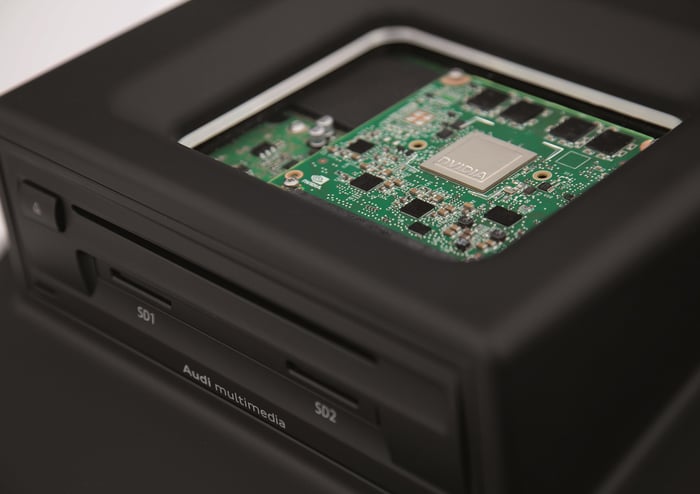
CD drive with top taken off to reveal chip board.

Image source: NVIDIA.

XPO gets an invitation

XPO Logistics saw its stock climb 8% following an announcement that the logistics company's shares will join a well-known index. S&P Dow Jones Indices announced late Friday that the company would join the S&P MidCap 400 index, as the index provider downgraded some shrinking companies to make space for XPO. For its part, XPO has struggled lately, as a key customer has looked at alternatives in getting its deliveries made. Yet even with that headwind, XPO is well-positioned within a growing industry, and favorable trends like rising volumes of e-commerce-related shipments should bode well for the delivery specialist's long-term prospects.

Infinera enjoys an upgrade

Finally, shares of Infinera picked up more than 9%. The company received favorable comments from analysts at MKM Partners, who upgraded their rating on the stock from neutral to buy. MKM also set a $6 price target, arguing that Infinera has a solid backlog of orders that includes some key new customers. Moreover, with a healthy pipeline toward getting more business, the fiber-optic specialist seems to be moving in the right direction. With signs that customers are finally starting to invest in IT infrastructure, Infinera stands to benefit greatly as its clients seek the best technology available.

Tuesday, March 12, 2019

Top Low Price Stocks To Buy For 2019

tags:UTMD,FCPT,ROP,

Ford (NYSE:F) is known for its attractive valuation, it currently trades at around 7 times its 2017 projected earnings and has an attractive dividend yield of 5.36 percent. It also has a very low price-to-earnings ratio (P/E) compared to most other companies on the S&P 500. The stock trades at around $11 during the time I am writing this. However, after digging a little deeper, I have found that the future looks bearish for Ford.

The automobile industry is known to be a very cyclical industry and I, along with many other people, believe that the cycle has peaked after years of high demand. We are witnessing a downtrend in automobile demand. In March, US auto sales fell 1.6 percent; 1.56 million cars and trucks were sold in March, falling below the projected sales of 1.62 million cars and trucks. Sales are down 1.6 percent compared to the same month last year. Ford only sold 236,250 cars; this is a 7 percent decrease in sales compared to the prior month.

Top Low Price Stocks To Buy For 2019: Utah Medical Products, Inc.(UTMD)

Advisors' Opinion:
  • [By Max Byerly]

    Utah Medical Products, Inc. (NASDAQ:UTMD) Director Ernst G. Hoyer sold 1,614 shares of the company’s stock in a transaction that occurred on Wednesday, May 9th. The stock was sold at an average price of $104.41, for a total value of $168,517.74. The transaction was disclosed in a filing with the Securities & Exchange Commission, which is accessible through the SEC website.

  • [By Joseph Griffin]

    Utah Medical Products (NASDAQ:UTMD) was upgraded by investment analysts at BidaskClub from a “buy” rating to a “strong-buy” rating in a research report issued to clients and investors on Monday.

  • [By Max Byerly]

    Utah Medical Products, Inc. (NASDAQ:UTMD) CEO Kevin L. Cornwell sold 8,080 shares of the firm’s stock in a transaction on Friday, June 15th. The stock was sold at an average price of $107.07, for a total value of $865,125.60. The transaction was disclosed in a legal filing with the Securities & Exchange Commission, which is accessible through this link.

Top Low Price Stocks To Buy For 2019: Four Corners Property Trust, Inc.(FCPT)

Advisors' Opinion:
  • [By Joseph Griffin]

    These are some of the media headlines that may have impacted Accern Sentiment Analysis’s scoring:

    Get Four Corners Property Trust alerts: FCPT Closes 46 Chili's Restaurant Properties for $149.8 million as part of Previously Announced Brinker Sale-Leaseback Transaction (finance.yahoo.com) FCPT Announces Acquisition of a Buffalo Wild Wings Restaurant Property for $1.7 million (finance.yahoo.com) Four Corners Property Trust (FCPT) vs. Sutherland Asset Management (SLD) Head to Head Analysis (americanbankingnews.com) FCPT Announces Acquisition of an Arby's Restaurant Property for $1.6 million (finance.yahoo.com) Four Corners Property Trust Inc (FCPT) Expected to Post Quarterly Sales of $35.62 Million (americanbankingnews.com)

    Shares of Four Corners Property Trust traded down $0.16, hitting $26.01, during trading hours on Friday, according to MarketBeat Ratings. The stock had a trading volume of 360,648 shares, compared to its average volume of 479,703. The company has a current ratio of 6.59, a quick ratio of 6.59 and a debt-to-equity ratio of 0.90. The firm has a market capitalization of $1.65 billion, a P/E ratio of 19.13 and a beta of -0.04. Four Corners Property Trust has a 12-month low of $21.28 and a 12-month high of $26.96.

  • [By Shane Hupp]

    Boenning Scattergood set a $30.00 target price on Four Corners Property Trust (NYSE:FCPT) in a research report released on Friday morning. The firm currently has a buy rating on the financial services provider’s stock.

  • [By Logan Wallace]

    Get a free copy of the Zacks research report on Four Corners Property (FCPT)

    For more information about research offerings from Zacks Investment Research, visit Zacks.com

  • [By Joseph Griffin]

    Neuberger Berman Group LLC trimmed its position in Four Corners Property (NYSE:FCPT) by 12.6% during the 1st quarter, according to the company in its most recent filing with the Securities and Exchange Commission (SEC). The firm owned 61,299 shares of the financial services provider’s stock after selling 8,843 shares during the period. Neuberger Berman Group LLC owned 0.10% of Four Corners Property worth $1,415,000 as of its most recent filing with the Securities and Exchange Commission (SEC).

  • [By Stephan Byrd]

    Get a free copy of the Zacks research report on Four Corners Property Trust (FCPT)

    For more information about research offerings from Zacks Investment Research, visit Zacks.com

Top Low Price Stocks To Buy For 2019: Roper Technologies, Inc.(ROP)

Advisors' Opinion:
  • [By Stephan Byrd]

    Geneva Partners LLC acquired a new stake in Roper Technologies Inc (NYSE:ROP) during the second quarter, according to its most recent Form 13F filing with the SEC. The firm acquired 1,125 shares of the industrial products company’s stock, valued at approximately $310,000.

  • [By Logan Wallace]

    Shares of Roper Technologies Inc (NYSE:ROP) have earned an average rating of “Buy” from the fourteen analysts that are currently covering the stock, MarketBeat Ratings reports. Five analysts have rated the stock with a hold rating and eight have issued a buy rating on the company. The average 1 year target price among brokers that have issued ratings on the stock in the last year is $303.58.

  • [By Shane Hupp]

    Norinchukin Bank The lifted its holdings in Roper Technologies Inc (NYSE:ROP) by 15.1% in the 1st quarter, according to the company in its most recent 13F filing with the Securities and Exchange Commission. The fund owned 9,423 shares of the industrial products company’s stock after purchasing an additional 1,238 shares during the period. Norinchukin Bank The’s holdings in Roper Technologies were worth $2,645,000 at the end of the most recent reporting period.

  • [By Neha Chamaria]

    Using the above method, I believe the following five stocks are some of the best Dividend Aristocrats to consider today.

    Dividend Aristocrat Payout Ratio (Last 12 Months) 5-Year Dividend CAGR*  10-Year Dividend CAGR* Ecolab (NYSE:ECL) 30.2% 12.9% 12.3% W.W. Grainger (NYSE:GWW) 45.7% 10.6% 14.2% Cintas Corporation (NASDAQ:CTAS) 23.7% 19.8% 13.1% Roper Technologies (NYSE:ROP) 14.6% 20.4% 18.5% A. O. Smith (NYSE:AOS) 33.6% 25.5% (2.2%)

    *Compound annual growth rate. Data source: S&P Global Market Intelligence. Table by author.

  • [By Ethan Ryder]

    Teacher Retirement System of Texas lifted its position in Roper Technologies Inc (NYSE:ROP) by 57.1% in the 2nd quarter, HoldingsChannel reports. The institutional investor owned 61,777 shares of the industrial products company’s stock after buying an additional 22,444 shares during the quarter. Teacher Retirement System of Texas’ holdings in Roper Technologies were worth $17,045,000 as of its most recent SEC filing.

  • [By Garrett Baldwin]

    Shares of General Electric Co. (NYSE: GE) are in focus after the company reported earnings before the bell. GE stock popped 5.6% after the firm topped earnings per share (EPS) estimates by $0.05 and backed its 2018 outlook. The firm reported EPS of $0.16 on top of $28.66 billion in revenue. GE stock had been off nearly 18% from its last earnings report on January 24 due to ongoing financial and legal problems. Crude oil prices dipped Friday after U.S. President Donald Trump took aim at OPEC. Trump accused the cartel of keeping oil prices "artificially high" despite "record amounts of oil all over the place." Brent crude and WTI crude oil both hit three-year highs this week after Saudi Arabia suggested that it was working to press oil prices back above $100 per barrel. Three Stocks to Watch Today: PM, MO, WFC Shares of Philip Morris International Inc. (NYSE: PM) fell this morning after the firm experienced its worst trading day since its spin-off from Altria Group Inc. (NYSE: MO). Shares of PM fell as much as 16% after the firm fell short of revenue expectations after the bell. MO stock fell roughly 6% on the day. Shares of Wells Fargo & Co. (NYSE: WFC) are under pressure after The New York Times reported that the firm may be facing a $1 billion fine. The fines would cover a variety of "alleged" misdeeds that include the firm's push on customers to purchase auto insurance they didn't need and charging mortgage customers fees for services that they were not using. The Consumer Financial Protection Bureau and the Office of the Comptroller of the Currency will most likely announce the fine today. Money Morning Capital Wave Strategist Shah Gilani weighed in on the topic this week, and he offers a scorching indictment. Qualcomm Inc. (Nasdaq: QCOM) is on the move today after the semiconductor giant announced plans to lay off 1,500 employees. The cuts are expected to hit employees in California and cities around the globe. The cuts are part of the fi

Monday, March 11, 2019

'As long as Nifty holds 10,800, any dip is likely to bought into'

Manali Bhatia

Slowdown in global economy is evident with factors such as lower GDP number for China, surge in US trade deficit to a record high, disappointing US jobless data and subdued Asian cues. Besides, decoupling on the domestic front is expected.

We suggest accumulating quality stocks in fewer quantities. Awaited elections, if favourable, then one can lock on the stated gain.

Around USD 2.37 billion were poured in by FIIs in the equity market in February, indeed this healthy buying still exists in March as well. It increases sentiment as FII "net seller" has now been the "net buyer" in the equity market.

related news Buy or Sell | Positive on market, banks likely to outperform Buying advisable in pharma with long-term view: Kotak Securities 'Level of 11,200 on Nifty could be make or break for this week'

Also, upswing in Nikkei India Composite PMI output index from 53.6 in January to 53.8 in February reflected a stronger and accelerated increase in private sector activity in the country. Strengthening of rupee at 70/dollar level followed by softening in crude oil prices to provide further comfort.

Furthermore, as inflation rate is already lower than estimated, RBI is expected to lower the interest rate in May thereon. With this, liquidity crisis is expected to polish off sooner than later.

The Pulwama attack, or to be slated as Indo Pak tensions, is mark under controlled. War situation has presently blown off. Intrepid actions taken by the current government on the same embark favourable winning chances in the upcoming elections.

On an upside, if 11,050 is traded on higher side, we can expect the rally to continue till previous top i.e. 11,118 and above this any breakout could result in pre-election rally till 11,324 and 11,550. Taking the broader view into perspective, Nifty is well placed above all major moving averages and until 10,800 holds, any dip is likely to bought into.

Here are the top stock trading ideas which can give good returns in the long term:

Exide Industries: Buy | CMP: Rs 224 | Target: Rs 262 | Return: 17%

Q3 numbers for Exide did not turn out to be very fruitful. Net profit stood at Rs 155 crore, mainly due to higher tax rate. Revenue stood at Rs 2497 crore against Rs 2278 crore, registering growth of 10 percent against previous year. EBITDA margin improved marginally 11bps at 12.5 percent against 12.4 percent in the previous year quarter primarily due to higher other expenses. Though, volumes in Automotive, Motorcycle, UPS and Solar Batteries in Q3 have grown well.

Going forward, the company's cost control measures and technology up gradation strategies would help to improve the bottom-line. Also, tie up for batteries having lithium-ion cell technology at its plant is expected to become operational by mid-2020 would add to improve company's performance and lower the raw material cost to some extent.

As, electric vehicles to be the next leg for growth combined with 2W growth expected to remain strong in the years to come due to increase in consumption & rural income. We remain positive for the sector and Exide industries to maintain its market share.

However, continued escalation in lead prices remains a major concern. Adding to that, muted auto sales numbers and competition pressures are also pulling back the margins.

Asian Paints: Buy | CMP: Rs 1384 | Target: Rs 1575 | Return: 14%

Asian Paints delivered Q3 results in line with our expectations; Volume growth has also picked up significantly, though business continued to face pressure from rising raw material prices.

Although crude oil prices were uptick during Q3 results, it had softened currently and is expected to remain range bound which would help improving the margins front.

Going forward, the commissioning of the Mysore plant as well as Vizag plant on board is expected to hit the market. Having said that is not enough, to stand out of the queue, it has entered home décor business as well- AP homes, to bring décor options under one roof and is planning to open up four more stores by the middle of July next year.

Also, company's products & market strategies are well on streamed. It has been repeatedly throwing various campaigns. One amongst is Royale Health Shield as the Gold Standard for aesthetics and protection for every home with Anti-Bacterial technology, keeping in mind consumer awareness and choices that are safe and hygienic, to establish.

Moreover, campaign launch to establish Ultima Protek as the 'Gold Standard' in protection for the exteriors of every home is expected to gain consumers traction. We expect all this efforts could make Asian Paints a unique moat among other competitors and outperform ahead.

The author is Senior Research Analyst at Rudra Shares & Stock Brokers

Disclaimer: The views and investment tips expressed by investment experts on moneycontrol.com are their own, and not that of the website or its management. Moneycontrol.com advises users to check with certified experts before taking any investment decisions. First Published on Mar 11, 2019 01:04 pm

Sunday, March 10, 2019

Currency Hedges Serve FMI International Well

It's been a rough half-decade for international stocks. Over the past five years, the MSCI EAFE index, a proxy for stocks in developed foreign countries, has returned an annualized 2.1%. That return reflects stock returns as well as currency movements—specifically, a rising dollar that has sapped the returns of U.S. investors in foreign firms. (A stronger dollar means that overseas earnings translate into fewer greenbacks here.) Account for those currency swings (funds typically try to hedge them by trading derivatives), and the index's return jumps to 6.6%.

See Also: 39 European Dividend Aristocrats for International Income Growth

FMI International (FMIJX, which employs a currency hedge, has therefore trounced the unhedged EAFE in recent years. But the fund, classified as a mix of growth and value stocks, also has an excellent track record against the hedged version of the benchmark. Since International's 2011 inception, its 8.3% annualized return beats the MSCI EAFE 100% Hedged index by more than a percentage point per year, with 23% less volatility.

The managers favor firms with competitive advantages in their industries; experienced, shareholder-friendly management teams; little debt; and robust returns on invested capital (a measure of profitability). Preferring to take deep dives into companies' finances, the managers avoid firms that may not adhere to strict financial disclosure or accounting practices. To be considered, a stock must trade at a discount relative to its own price history as well as to its peers. Plus, the managers must be convinced that the discount is due to a temporary problem that the firm can overcome.

Safran, the French maker of jet engines, is an example of such a firm. FMI added the stock to the portfolio in early 2018, after Safran acquired aerospace firm Zodiac. Trepidation about the deal had unfairly deflated Safran's stock price, as had investor concerns over narrowing profit margins, says FMI research director Jonathan Bloom. Safran has returned nearly 31% since the fund purchased it.

FMI International lags when foreign stocks are going gangbusters but makes up ground when stocks slide. In 2011, when the MSCI 100% Hedged index surrendered 12.1%, the fund lost only 1.8%.

Data as of February 15. **Closed to new investors. DATA SOURCE: Morningstar Inc.

See Also: The Best Emerging-Markets Stocks for 2019 Show comments

Saturday, March 9, 2019

Costco Wholesale Corporation (COST) Q2 2019 Earnings Conference Call Transcript

Logo of jester cap with thought bubble with words 'Fool Transcripts' below it

Image source: The Motley Fool.

Costco Wholesale Corporation (NASDAQ:COST) Q2 2019 Earnings Conference Call March 7, 2019, 5:00 p.m. ET

Contents: Prepared Remarks Questions and Answers Call Participants Prepared Remarks:

Operator

Good afternoon. My name is Vincent and I'll be your conference operator today. At this time, I would like to welcome everyone to the Q2 Earnings Call and February Sales. All lines have been placed on mute to prevent any background noise. After the speaker's remarks, there will be a question-and-answer session. If you would like to ask a question during this time, simply press "*1" on your telephone keypad. And if you would like to withdraw a question, press "#".

Thank you. I'll now turn the call over to your speaker today, Mr. Richard Galanti, CFO. Sir, you may begin.

Richard Galanti -- Executive Vice President and Chief Financial Officer

Thank you, Vincent, and good afternoon to everyone. I'll start by stating that these discussions will include forward-looking statements within the meaning of the Private Securities Litigation Reform Act of 1995. These statements involve risks and uncertainties that may cause actual events, results, and/or performance to differ materially from those indicated by such statements.

The risks and uncertainties include, but are not limited to, those outlined in today's call, as well as other risks identified from time to time in the company's public statements and reports filed with the SEC. Forward-looking statements speak only as of the date they are made and the company does not undertake to update these statements except as required by law.

In today's press release, we reported operating results for the second quarter of fiscal 2019, the 12 weeks ended February 17, as well as February retail sales for the four weeks ended this past Sunday, March 3. Note that the first two weeks of February fell into this second fiscal quarter, with Weeks 3 and 4 of February are the first two weeks of our fiscal third quarter.

The reported net income for the quarter came in at $889 million or $2.01 per share, a 27% increase compared to the $701 million, or $1.59 per share, last year in the quarter. In terms of sales, net sales for the quarter came in at $34.63 billion, a 7.3% over the $32.28 billion reported last year in the second quarter. Comparable sales for the second quarter, as shown in the press release, for the 12 weeks on a reported basis, U.S. was 7.4%, Canada was minus 0.3%, other international 0.7%, for the total company of 5.4%. As well, e-commerce for the 12 weeks on a reported basis was 20.2%.

Excluding gas deflation, the impact of FX, and some weakening foreign currencies relative to the dollar, as well as revenue recognition, which is an impact this year, the 7.4% reported in the U.S. would have been 7.2%; the minus 0.3% in Canada would have been plus 6%; other international, instead of being 0.7% reported would be plus 4.8%, with total company, the 5.4% reported would become 6.7%. And, again, e-commerce, reported at 20.2%, ex-gas, FX, and rev rec, 25.5% plus.

In terms of Q2 comp sales metrics, second quarter traffic, or shopping frequency, increased 4.9% worldwide and 5.2% in the United States. Weakening foreign currencies relative to the U.S. dollar negatively impacted sales by approximately 140 basis points and gasoline price deflation was another minus 50 basis points of impact. Rev rec actually benefited comp sales by about 55 basis points to the positive. These are the three factors that we adjust for and that are presented in today's release as the adjusted column.

In addition, weather conditions adversely impacted Q2 sales by around a half a percentage point and cannibalization weighed in on the comps by about negative 70 basis points.

In terms of front-end transaction, or what we call ticket, average front-end ticket was up 0.4% during the quarter and, excluding the impacts from gas deflation, FX, and rev rec, our average ticket was up approximately 1.8%.

Going down the income statement, membership fee income, reported, came in at $768 million, or 2.22%. That's up $52 million or 7.3% from a year ago. Again, with weak foreign currencies, if you adjusted for flat FX, that would make the up $52 million another $9 million up, or up $61 million year-over-year ex-FX.

Reported membership revenue of the plus $52 million amount, that's a little more than half of that -- a little more of $20 million of that related to the membership fee increases taken in June of 2017 in the U.S. and Canada. We're now nearing the end of that 23-month cycle to recognize the incremental benefit of the fee increases, what is known as deferred accounting, into our P&L. The benefit to our P&L will be fully recognized in the next two quarters, by the end of the fiscal year, but as with this last couple of quarters, it diminishes each quarter. In Q3, we'll have about half the benefit recorded in Q2 and, in Q4, it will be a very small benefit.

In terms of renewal rates in the second quarter, our U.S. and Canada member renewal rates in Q2 came in at 90.7%, up from 90.5% 12 weeks earlier at Q1 end. And, worldwide, the rate improved to 88.3%, up from 88% at Q1 end. So, improvement in our renewal rates.

In terms of the number of members at Q2 end, member households and total cardholders, we ended Q1 12 weeks earlier with 52.2 million member households. At Q2 end, there was 52.7 million. And total cardholders increased from 95.4 million at Q1 end to, 12 weeks later at Q2 end, 96.3 million.

During the quarter, we had one new opening in Coral Springs, Florida, and we also relocated a Miami location.

At Q2 end, our paid Executive Membership base stood right at 20 million. This was an increase during the quarter of 341,000, or about 28,000 per week since Q1 end. Now, this include the recent introduction of the Executive Membership in Korea, which is our fifth country offering Executive Membership. For Q2, Korea contributed a little over half of those increases.

Going down to the gross margin line, reported gross margin in the quarter came in at 11.29%, up 31 basis points from last year's Q2 '18 of 10.98%. The 31 basis point improvement, ex-gas, FX, and rev rec, would be plus 30 basis points.

I'll give you the chart. There's not a whole lot to it, given that the adjustment column is not that different than the reported column. In terms of core merchandise, year-over-year in Q2, was up one basis point on a reported basis, as well as ex-gas deflation and the rev rec, up one basis point. Ancillary businesses up 33 on a reported basis and up 32 on an adjusted basis. Two percent reward, minus three and minus three basis points year-over-year. And then total, up 31 basis points, as I just mentioned, on a reported basis, and up 30 basis points ex-gas deflation and rev rec.

The core merchandise component, again, was higher by one basis point here. Looking at the core merchandise categories in relation to their own sales, what we call "core on core," margins year-over-year were higher by eight basis points. Within the four key subcategories, both food and sundries and fresh foods were up a little and softlines and hardlines were down a little. But the net of the four departments on their own sales was up eight basis points.

Ancillary and other business gross margin was up 33 basis points, up 32 ex-gas deflation and rev rec, primarily driven by gas and also benefiting somewhat from e-commerce and a few other things.

Moving to SG&A, our SG&A percentage Q2-over-Q2 was lower or better by two basis points, both with and without the adjustments, coming in at 10% of sales this year compared to 10.02% last year. In the chart that I normally give out, there really is not a whole lot to tell you. Operations was an improvement of two basis points in both columns. The other two line items that we usually point out, central and stock compensation expense, were zero and zero. So, the total remained at two basis points. So, overall, two basis points better.

In terms of that two basis points better, we feel it was a pretty good result given that we're still facing the headwinds from the U.S. wage increases to our hourly employees that went into effect last June 11th of 2018. As mentioned in the past couple of fiscal quarters, those wage increases negatively impacted SG&A by about 7-8 basis points during Q2 year-over-year. And it will continue to impact SG&A comparisons through Q3, which ends May 12th, and into the first month of our 16-week fiscal fourth quarter to anniversary on that June 11th.

Additionally, this past Monday, we began our new three-year employee agreement. With the new agreement, we announced that we're taking our starting wages from $14 and $14.50 up to $15 and $15.50 per hour in both the U.S. and Canada. In addition, we're also increasing wages for supervisors and also introduced paid bonding leave for all hourly employees. These items are incremental to the usual annual top-of-scale wage increases that are typically done each March. Collectively, these additional items will add about 3-4 basis points to SG&A over the next four quarters. Now, again, this is on top of that 7-8 basis point impact I just mentioned that will impact SG&A through this coming mid-June.

Otherwise, pretty comparable year-over-year, in terms of central and stock comp and other various SG&A expense line items.

Next on the income statement is pre-opening. Pre-opening expenses were actually lower by $3 million, coming in this year at $9 million compared to $12 million last year. This year, again, we had two openings: one net opening and one relocation. Last year, we actually just had one opening. There's other activities that relate to pre-opening as well. Year-over-year, primarily, the difference was due to the $4 million in Q2 last year related to our opening of our new meat plant in Morris, Illinois, slightly offset by higher warehouse pre-opening this year due to the additional opening.

All told, reported operating income in Q2 '19 was up 18.4%, coming in at $1.203 billion this year compared to $1.016 million last year.

Below the operating income line, reported interest expense was $3 million lower or better year-over-year, coming in at $34 million this year in Q2 as compared to $37 million last year. The actual interest expense quarter-over-quarter each year is about the same, a little delta and improvement in capitalized interest amounts.

Interest income and other for the quarter was better by $39 million year-over-year. Interest income itself was higher by $17 million year-over-year in the quarter, a combination of higher interest rates being realized and also higher invested cash balances. Also benefiting year-over-year comparison were the various FX items in the amount of $22 million. Recognize that much of this is essentially an offset to the lower reported operating income and earnings in our foreign operations due to the strength of the U.S. dollar versus many of the foreign currencies in the countries where we operate compared to last year.

Overall, pre-tax income in Q2 was up 23%, coming in at $1.215 billion this year compared to last year, $986 million.

In terms of income taxes, our income tax rate was a little better than we had anticipated. It came in at 25.8% effective tax rate during Q2 '19 compared to 27.7% in Q2 last year. For all of fiscal '19, based on our current estimates, which, again, are subject to change, we anticipate that our effective total company tax rate for this fiscal year to be approximately 26% to 26.5%. This figure is about a half a percentage point lower or better than we had previously estimated a quarter ago. This is primarily due to a Q2 tax rate that now includes a one-time benefit for certain foreign tax credits. This one-time tax benefit will continue through the end of this fiscal year but we do not anticipate a similar type of benefit beyond fiscal '19.

A few other items of note. Again, we opened a net one unit during Q2. Opened two, including a relocation. In Q3, we have three new openings planned and no relocations. We actually opened this morning in Bayonne, New Jersey. In late April, we plan to open our 16th location in Korea and, in early May, our 11th location in Australia. The big expansion quarter for us this year is Q4. We plan to open a net of 12 units -- 14 openings, including two relocations -- including our first opening in China in Shanghai in the city of Manjung and also our third unit in Spain, which would be our second in the Madrid area. Though any of these could slip a little bit but our current best guess right now is 14 openings, including two relocations, so a net of 12.

As of Q2 end, total warehouse square footage totaled 112 million square feet.

I might also add that, in terms of capex, we continue to allocate more capex to grow and support our operations, including, as you know, over the last year, year and a half, we've opened a second meat plant -- the first one in California many years ago and then in Morris, Illinois. Also, a little while ago, our Canadian bakery commissary in Canada. We are under construction with the big chicken plant in Nebraska. We plan to start initial processing and production later this year. Depot expansion, we're doing that in many areas around the world. Also, we just, a month ago, I believe, we started up our first, what we'll call, fulfillment automation operation as part of our Mira Loma depot. This is for small packages for e-commerce and we plan to do two more of those this year at other depots.

In terms of two-day grocery, which, as you know, we started in October, about a year and a half ago, we did that out of 10 or 11 of our business centers around the country. We're in the process of moving these operations out of the 10-11 business centers to six of our depots over the next several months. I think we've done our first one and we've got several more planned right around the end of spring, beginning of summer.

In terms of stock buybacks in Q2, we expended $117 million to repurchase 561,000 shares at an average price of $208.72. $117 million, of course, is significantly higher than the Q1 purchases of $35 million.

In terms of e-commerce, overall, again, e-commerce sales increased during the quarter on a reported basis 20.2% and, ex-FX and rev rec, up 25.5%. Continued increases in e-commerce in terms of orders and sales and profits and other metrics. Top growth categories in the quarter -- quite a few, actually. Grocery, consumer electronics -- what we call "majors" -- hardware, health and beauty aids, tire, automotive, toys, seasonal, and apparel.

We have now passed our one-year anniversary on the grocery launch, which was, again, a year ago in October. Same-day grocery delivery is now available to members within a short drive of 99% of our U.S. locations. Two-day grocery is available anywhere throughout the continental United States. And while, still, these are small pieces of our total business operation, they are growing nicely. We now have grocery shipments to all 50 states.

In terms of e-commerce, in terms of new brands and items online during the quarter, we're now offering a much broader selection of Apple products, including the recent edition of MacBooks and iMacs. And, yes, you'd expect good values to our members. Also, the first of what we expect several products from Sony, they just started to arrive. In terms of health and beauty aids, new names like Living Proof shampoo and conditioner, Murad skin care, and K Somerville items. On the exercise front, NordicTrack is a new name. And, finally, I had to point out the now somewhat famous 180-serving, 23-pound, 20-year shelf life macaroni and cheese for $89.99. If interested, you can find that online under "emergency supplies" and in a few of the Costco locations.

We continue to improve our online and in-store cross-marketing initiatives and we think that's continuing to drive our business. In terms of buying online and pick up in store, in the quarter, we expanded our selection within the same categories -- jewelry, some electronics, and handbags -- and continue to test pick-up lockers in 10 locations for this program.

Lastly, this calendar year, we will begin e-commerce operations in Japan early summer, likely, and in Australia, late summer or early fall.

Finally, I'll turn to our February sales results for the four weeks ended March 3, 2019 compared to the same period a year ago. As reported in our release, net sales for the month came in at $10.72 billion, an increase of 5% from $10.21 billion a year earlier.

In terms of comparable sales, U.S. on a reported basis for the four weeks was 6%. Ex-gas, FX, and rev rec, that 6% would be 5.7%. Canada, on a reported basis, 0%; ex-gas, FX and rev rec, plus 4.8%. Other international reported minus 5.9%; and, again, adjusted with ex-those things, minus 1.2%. Such that total company came in at 3.5% reported and 4.6% ex-those items.

In terms of e-commerce, reported for the four weeks, 24.2%, and ex-those appropriate adjustments, 21.6% up.

February sales were negatively impacted by weather throughout the U.S. and Canada in a big way. We estimate that negative impact on the total company was approximately 1% and a little more than the 1% in the U.S. and Canada.

In addition, Lunar New Year, Chinese New Year occurred in February, the same as last year. However, 11 days earlier this year. This is an important holiday in terms of sales strength. The holiday shift negatively impacted February's other international sales by, we estimate, 450 basis points or 4.5 percentage points, and total company sales by about half a percentage point. Looking at January and February combined, effectively eliminating the impact of that holiday shift, the comp for other international of the eight weeks was 0.2% reported and plus 4.9% ex-FX, gas deflation, and rev rec.

U.S. regions with the strongest results in February were Midwest, Northeast, and Southeast. And, internationally, the strongest results were Mexico, Japan, UK, and Spain. Spain, of course, is relatively new with two locations.

Foreign currencies year-over-year relative to the U.S. dollar hurt February comp sales in Canada by approximately 460 basis points, other international also by about the same number of basis points, about 4.5 percentage points, and total company by an estimated 130 basis points.

The negative impact of cannibalization was about 50 basis points to the negative in the U.S., 80 in Canada, and 120 in other international, for total company of minus 70.

Within ancillary businesses, hearing aids, optical, and food court had the best comp sales in February. Gas price deflation negatively impacted total reported comps by about 75 basis points. The average selling price during the four-week month compared to the year earlier was down 6.3% year-over-year. The average gallon a year ago, we sold for $2.74; this year, $2.56 a gallon.

Including the adverse impact of weather and a holiday shift in Asia, our comp traffic or frequency for February, even after taking those impacts into effect, was up 2.7% worldwide and plus 3.2% in the U.S. For February, the average transaction was 0.8% for the month. Again, this includes combined impacts from FX, gas deflation, and rev rec.

So, that's about it in terms of our prepared notes. Lastly, in terms of upcoming releases, we'll announce our March sales results for the five weeks ending Sunday, April 7th, on April 10th after the market closes.

With that, I'll open it up to Q&A and turn it back over to Vincent. Thank you.

Questions and Answers:

Operator

At this time, I would like to remind everyone, in order to ask a question, please press "*1" on your telephone keypad. Again, that would be "*1" on your telephone keypad. We'll pause for just a moment to compile the Q&A roster.

We have your first question. It comes from the line of Christopher Horvers from J.P. Morgan. Your line is now open.

Christopher Horvers -- J.P. Morgan -- Analyst

Thanks. Good morning, Richard. So, a question on the core margins. The core margin's performance this quarter was much better sequentially, I think. Everyone was sort of taken by surprise by the core margins, ex-gas in the last quarter, and now they're looking much better. So, can you put into context what sort of drove that change and any commentary about how you're thinking about core margins as you look forward?

Richard Galanti -- Executive Vice President and Chief Financial Officer

Honestly, we drive our business by driving sales and usually that means lowering prices on things, which we continue to do. We're also buying better all the time. Some of it is mix. Some of it -- the one category that shifted, if you look back at the last few quarters or reports when we look at quarter-over-quarter, fresh foods has been a little down. And I think the key word there is "little." I appreciate the fact that every basis point, for us, is $14 million plus pre-tax a year on $140 plus billion. But you're talking about 5-10 basis point swings here.

And there's lots of things that impact it, whether it's freight, tariffs, somewhat to the negative, in some cases not as bad as we thought. I think we've done a great job and we continue to do a great job, particularly in fresh food and organics, where I believe there's a little less pricing pressure or competitive pressure. But don't get me wrong. As soon as we have a good quarter in the next quarter, we'll change that. Not that I'm giving any guidance. We know that we keep it pretty steady and we feel pretty good about it, whether it was up a few basis points or down a few basis points.

Christopher Horvers -- J.P. Morgan -- Analyst

Got it. And then just a question about the gas margins industry wide. I understand there are a few ways that gas impacts margin but if you just focus on the fact that it seems like the core cents per gallon has improved across the industry, the independents maybe and the integrated taking a little bit more, and that's given you some room to take a little bit more. So, can you talk about what you're making per gallon, I guess, relative to last year and maybe a couple years before that? And as you think about the upcoming year, is there anything that you're seeing that would suggest that that core profitability of every gallon sold is all of a sudden going to revert back to what it was a number of years ago?

Richard Galanti -- Executive Vice President and Chief Financial Officer

I think over the last several years, the new normal is better. If you go back to when gas prices skyrocketed several years ago and as they started coming down, what we saw and what we read, frankly, from others is that, as they came down, not all of those savings were passed on to the consumer. They gave us, perhaps, a little bit bigger window. We're still -- I think if you ask our people in charge of gas operations around here, we're saving the customer a little more today and making a little more because there's just a bigger opportunity and gap there. It really comes down to that. It is still a volatile, no pun intended, profitability item. It can swing back and forth based on underlying cost of goods sold that change daily. But the new normal is better in all those examples.

But I'm sure there'll be quarters -- Q2 was a particularly good quarter, as I believe Q2 a year ago was a little better than the other three. But not seasonal, necessarily. There's a lot of different factors. What's going on in the news internationally, what's going on with inventory levels, world and U.S. inventory levels, what's going on with -- inevitably, a refinery shuts down for two weeks for their planned repairs and it takes four weeks. So, any of those things, switching from winter to summer blend and back, all those things impact it. I think we're fortunate in the fact that we turn a lot of gas. We literally turn our inventory about daily. And, as you know, we have locations with up to 24 pumps and they're backed up all the time. It's great.

And so I think we're in a fortunate position that, overall, retailers, whether it's retailers that have gas in their parking lots, like supermarkets and discount stores and ourselves, or independent retailers or the ones with the convenience stores, I think everybody seems to have been taking a little bit more and that's given us the ability to do so in the last couple of years. But I guarantee you, it will be volatile and we'll always tell you that -- it was certainly a little more of a benefit this quarter than normal but it was a year ago too.

Christopher Horvers -- J.P. Morgan -- Analyst

So, then just a quick one on that. So, of the 30-odd basis points in ancillary this quarter, should we assume some portion of that comes out next year in the second quarter? Anything that you would say is one-time that we should put back next year and be half of it?

Richard Galanti -- Executive Vice President and Chief Financial Officer

I wouldn't use the word one-time. I'd say unpredictable. I mean, it truly is not predictable. I mean, we know that when demand rises at the beginning of summer, gas prices has a little bit more positive pressure on them. And when prices are going up, not only for us but what I read the profitability of gas at other big retailers, supermarkets and Walmart and the like, it impacts them as well. When prices are going up, we all make a little less. When prices are going down, we make a little more. We, I think, are in the enviable position of being extreme. And as, overall, the retail environment has chosen to make a little more, it gives us the ability to make a little more, a little less than a little more, and still make more but even be a greater savings to our members. That's the thing that we focus on. Are we saving our member more than we used to? And we are.

Christopher Horvers -- J.P. Morgan -- Analyst

Understood. Thanks very much.

Operator

Your next question comes from the line of Simeon Gutman from Morgan Stanley. Your line is now open.

Simeon Gutman -- Morgan Stanley -- Analyst

Hey, Richard. A follow-up on the gross margin or the core margin. You mentioned mix helped a little. Can you dig in? Anything about mix that was either seasonal or something that is changing? And you said you would always lower product acquisition costs. Can you remind us when your own chicken plant is coming up? And then one more in that mix. Can you tell us, the channel mix between physical and digital, is that sort of embedded gross margin improving as well?

Richard Galanti -- Executive Vice President and Chief Financial Officer

Well, overall, gross margin online is a little lower than our company overall. Part of it is the product mix itself and part of it is we're driving that business. But that hasn't changed. That's been that way. We also work on a lower SG&A online, as you might expect.

In terms of mix, there's so many different pieces to it, honestly. Part of it is, when you walk into a Costco in the U.S., roughly 90% of the goods come through our cross-dock operations. For us, cross-docks are very profitable. It's the most cost-efficient way to ship stuff. Nobody can do that to the extent that we do it because of how we sell goods, in pallet and large-case quantities. So, I mean, there's lots of little pieces to it. I think private label and continued penetration in private label, fresh, but all these are anecdotal. There's no one thing that's driving it in a particularly large direction. We think we're pretty good at what we do and we're constantly buying better. Even as it related to tariffs, which so far, so good, in terms of being on hold, we don't know what's going to happen in the future. I think bigger retailers have an ability to buy better.

Simeon Gutman -- Morgan Stanley -- Analyst

Right. And then shifting to SG&A, in the past, I think you've talked about, as long as your comps hold up in mid-single digits, you're leveraging, and that was based on some intuitive rate of spending. There was IT, there was technology. Has anything on the spending side changed? Any curve that's increasing/decreasing and that same mantra about mid-single digit comps, that should still maybe be good enough to give you leverage?

Richard Galanti -- Executive Vice President and Chief Financial Officer

Well, hopefully, it will. While the word modernization, I think, has finally been retired around here, we're still spending a lot and we're going to continue to spend a lot. As some of these new things come online, like the chicken plant, like the fulfillment automation, these are $50 million to $100 million plus items -- the chicken plant is more -- where a bigger chunk of it is things like equipment and software that is depreciated over a shorter period of time than steel buildings. So, all those things are hitting us a little. I think the fact is we've been fortunate with our sales levels. As they go down, that'll hurt us a little. We're achieving our current SG&A with all of the things that we haven't talked about, some of these other items that impact it the other way. There's lots of little things. And we're not terribly worried, though, if some of these things -- if sales were to come down a little and some of these things would be impacted, so be it. We're going to do what we do and drive the top line.

Simeon Gutman -- Morgan Stanley -- Analyst

Thanks, Richard.

Operator

Next question comes from the line of Chuck Grom from Gordon Haskett. Your line is now open.

Chuck Grom -- Gordon Haskett -- Analyst

Hey. Good afternoon, Richard. Just on the pricing front, I'm curious how you guys are handling increases in certain categories, including any of those that may be impacted by tariffs. Just are you looking to pass along those increases and do you think that may have helped out the core margins at all here in the second quarter?

Richard Galanti -- Executive Vice President and Chief Financial Officer

I don't think it would have helped the margins. The question is did it hurt it or not hurt it. It probably hurt it less than one might think. But that, again, gets back to our ability to buy right. And to the extent there's 10% tariff items, those examples, versus 25%, that's a big difference. In some cases, you've got your vendors, along with us, eating into that a little bit. Sometimes, not. But I think it gets back, that's just one piece of what we do. The fact that organic helps us, the fact that KS helps us, the fact that -- we don't talk about it, nor will we plan to, a lot but all the marketing dollars that are out there now. Some of those impact cost of sales.

Chuck Grom -- Gordon Haskett -- Analyst

Okay. Then I guess just to follow up on Chris' question, you've had three consecutive quarters in a row of the core-on-core-on-core being negative and then this quarter it flips to positive. Is there anything else you can point to?

Richard Galanti -- Executive Vice President and Chief Financial Officer

Yeah, I wouldn't read a lot -- look, we're happy about it and, hopefully, you're happy about it. It's how we run our business. We didn't sit there and say, hey, let's get it up a little higher. I know we're a basis point company and for you guys who have known us for 30-plus years, we talk basis points. It's some minor switches. It's nothing that we've changed dramatically. And there's so many different moving parts to it, frankly.

Chuck Grom -- Gordon Haskett -- Analyst

Understood. I guess the other bright spot here in the quarter was the renewal rates are ticking up nicely. If you look back at the cadence in '18, they were pretty steady but they're showing a nice uptick, both in the U.S. and worldwide. Just wondering if you could comment on that improvement.

Richard Galanti -- Executive Vice President and Chief Financial Officer

Well, we like it. Look, we focus on all the things that we feel we should be focusing on: customer service, great products, great services at the best prices. We've been fortunate, notwithstanding the fact that we really don't have a PR department, per se, there's been a lot of good press about us, about Kirkland Signature, about our e-commerce site and customer satisfaction. I think that we have been blessed that some of the weaknesses that traditional brick-and-mortars or traditional formats have had, in some ways, have helped certain other discounters like ourselves. And hopefully that will continue.

Chuck Grom -- Gordon Haskett -- Analyst

Great. Thank.

Operator

Your next question comes from the line of Edward Kelly from Wells Fargo. Your line is now open.

Edward Kelly -- Wells Fargo -- Analyst

Hi. Good afternoon, Richard. I wanted to start with just a follow-up on fuel. If we were thinking about trying to strip out fuel and the impact, do we take the majority of the 33 basis points in order to do that? And then is there any intentional reinvestment to sort of consider as we think about this?

Richard Galanti -- Executive Vice President and Chief Financial Officer

On the latter part of the question, there's no intentional reinvestment. I mean, there's 100 different moving parts to our company all the time and we do what we feel is right. It's kind of like the question I was asked a year ago. We were asked would the extra earnings from the lower tax rate, will that change what we're doing with automation, online fulfillment, or whatever else. And the answer was, of course, no. we've got more cash than we spend. This will add to that and that's all good but we're constantly figuring out what other things we can do there.

What was the first part of your question? I'm sorry. It was something on fuel.

Edward Kelly -- Wells Fargo -- Analyst

Just trying to -- yeah.

Richard Galanti -- Executive Vice President and Chief Financial Officer

We don't disclose every component. It certainly was the biggest piece of it.

Edward Kelly -- Wells Fargo -- Analyst

Okay. And the last quarter, you mentioned a little bit of competitive pressure, specifically talked about Sam's and Fresh. I'm just curious if you could give us an update on the competitive backdrop, what you're seeing. And then, as part of this, it seems like we're starting to see maybe a little bit of food price inflation. I'm just curious on your thoughts on pass-through, I guess, and expectations for the year.

Richard Galanti -- Executive Vice President and Chief Financial Officer

Well, I think the key word on inflation is "little." We're not seeing -- other than the tariff impacts on things. But in terms of food and what have you, it is, frankly, very little. And, over time, it will go up. Our comments over the years have we'll be the last to go up and the first to go down and I think that holds true as well.

In terms of the comment last time on Sam's, that was an interesting comment because I think, after the call, the headline in the press was that's why margins were down. And the fact of the matter is we call it out because we're pretty transparent. Sam's, and others, but Sam's has been more competitive, as are we. And that's the nature of the business and it has been for 30 years. We see that continuing. And I think the fact that it's continuing and we still show improvement in some of these things is a good sign for us.

Edward Kelly -- Wells Fargo -- Analyst

Great. Thanks, guys.

Operator

Next question comes from the line of David Schick from Consumer Edge Research. Your line is now open. David Schick, your line is now open. Your next question comes from the line of Karen Short from Barclays. Your line is now open.

Karen Short -- Barclays -- Analyst

Hey. Thanks very much. Sorry to harp on this gas margin question or gas profit question but is there any way you could just help us get a feel for how much it benefited EPS this quarter? Because the data we saw on gas margins for the quarter throughout your whole market area was just astronomically high gas margins.

Richard Galanti -- Executive Vice President and Chief Financial Officer

When you say "our area," throughout the United States?

Karen Short -- Barclays -- Analyst

Well, we map it by kind of stores by state.

Richard Galanti -- Executive Vice President and Chief Financial Officer

Okay.

Karen Short -- Barclays -- Analyst

But West was particularly strong.

Richard Galanti -- Executive Vice President and Chief Financial Officer

Yeah. We don't disclose that. Again, it was well more than half but not all.

Karen Short -- Barclays -- Analyst

Okay. And then, I guess, just wondering a little bit, in terms of the wage increase that you called out for March, is there anything to think about in terms of the basis point impact as we get into the next quarter?

Richard Galanti -- Executive Vice President and Chief Financial Officer

Yes. I mean, starting March 4th, this past Sunday, I think I indicated on top of the 7-8 basis points that will continue through June 11th, if you will -- so, all through Q3 and the first four weeks of the 16-week fourth quarter -- effective March 4th, we'll have that, in addition, on top of that, 3-4 basis points.

Karen Short -- Barclays -- Analyst

Okay. So, the year-over-year impact --

Richard Galanti -- Executive Vice President and Chief Financial Officer

And that 3-4 basis points will be March 4th to March 3rd of 2020, if you will.

Karen Short -- Barclays -- Analyst

Three to four basis points. Okay. And then just wondering if you could call anything out in terms of tax refund data, like in terms of your expectations on driving sales? There's a lot of noise on the timeline of that but any color, what you're thinking it will do to comps or not do, I guess.

Richard Galanti -- Executive Vice President and Chief Financial Officer

Well, honestly, I haven't heard anybody here talk about that and I've read some of the same things that you've read. It started off in the period, it was a little lower, and now it appeared it was a little higher. Not a lot higher, but a little higher. Typically, on a macro basis, that impacts retail overall. And whatever impact it has to that, it's typically a little less to us. That's what we've seen historically, whether it was a change in tax rates or dividend rates or you name it, EBT, food stamps, whenever there's any kind of macro change that impacts retail across the United States, there's a little bit less of an impact to us. But we've not really seen or even know how to answer that.

Karen Short -- Barclays -- Analyst

Okay. And then just last question. I know that you don't want to have people get in the habit of assuming that there will be a special dividend on a regular basis but any thoughts on your philosophy on that as it relates to the timing within this year? Because we're at the two-year mark.

Richard Galanti -- Executive Vice President and Chief Financial Officer

Yeah. I mean, our thoughts continue as they have been. The three we did were about two and a quarter years apart but that doesn't mean anything going forward. It's still a topic on the table and we continue to talk about it along with other things. So, really, not a whole lot of news to tell you about.

Karen Short -- Barclays -- Analyst

Okay. Thank you.

Richard Galanti -- Executive Vice President and Chief Financial Officer

Yeah. Thank you.

Operator

Your next question comes from the line of John Heinbockel from Guggenheim Securities. Your line is now open.

John Heinbockel -- Guggenheim Securities -- Analyst

So, Richard, what are you guys seeing with regard to inbound freight? Is that a slight directional drag? And then, if anything, what are you doing to mitigate that?

Richard Galanti -- Executive Vice President and Chief Financial Officer

I'm shooting from the hip a little on this one but I believe, while it's been up a little bit because of new restrictions on how many hours long-haulers can drive and just truck capacity out there, it's gone up for everybody, I believe we internally look at it in our freight department as a freight factor or premium factor or fuel factor -- whatever we call it. I forget. And it's up a little less than it was a couple of months ago but it's still up. And it's come down a little bit from where it was but it's still up from a year ago is my guess.

John Heinbockel -- Guggenheim Securities -- Analyst

Okay. And you've had the adjustment item in gross margin related to some supply chain investments, not there now. Is that now gone for the duration or does that come back with other supply chain investments that you might make, whether it's the chicken plant or other depots?

Richard Galanti -- Executive Vice President and Chief Financial Officer

One of the things was the return centers we talked about for a few quarters. I think there's more things happening that impact us a little bit negatively to start. We opened a new meat plant, major capital expenditure. First, it takes a few things out of our Tracy meat plant that goes to the East Coast. With Tracy, we couldn't accommodate all our needs just from that plant. And then you've got a new plant that's starting with its own -- even though we know how to run one -- it has its innate inefficiencies when you first start and it's not at full capacity. Same thing with the commissary, which was more of a learning experience over the last two years in Canada. I think all these things will impact us. A comment I made earlier is we're not going to point out each one of these but, in the aggregate, my guess is it's still a little bit of a drag which is offset by other things, most particularly sales.

John Heinbockel -- Guggenheim Securities -- Analyst

All right. And then, lastly, there was a period there where you'd stepped up the growth of the business centers for a period of time. What's the philosophy now on where they go, U.S. or internationally, as part of your expansion over the next couple of years?

Richard Galanti -- Executive Vice President and Chief Financial Officer

I think, right now, we have one in Canada and what? Sixteen in the U.S.? I would expect one or two a year for the next couple of years, which is not really a change of what we thought. The change was several years ago when we went from zero to eight over a million years, over a long period of time, and then we started opening a couple a year. And so we'll continue to open a few but we're not -- it's part of the plan but our focus is regular warehouses and, quite frankly, a lot of the infrastructure things that we're doing now. We'll continue to do it in a bigger way.

John Heinbockel -- Guggenheim Securities -- Analyst

Thanks.

Operator

Your next question comes from the line of Scot Ciccarelli from RBC Capital. Your line is now open.

Scot Ciccarelli -- RBC Capital Markets -- Analyst

Hi, guys. Scot Ciccarelli. Richard, with your first opening in China coming up, what is the best way to think about U.S. versus international store openings over the next, call it, 2-3 years? And then related to that, any reason why we should see international profitability levels decline as you start to move into some of these new markets, like China?

Richard Galanti -- Executive Vice President and Chief Financial Officer

Well, first of all, if you'd asked us five, six, seven years ago, by now, what percentage of our units would be outside of the U.S. and Canada -- and I include Canada as part of the original, mature, fully grown-out area -- that, by now, we'd probably be 50/50 international, outside of the U.S. and Canada. And we're not. It's 65/35, 70/30 U.S./Canada still. Part of that is the opportunities that we've had in the U.S. and Canada. And part of it is the pipeline is taking a little longer elsewhere. I think you'll continue to see that change and the direction is toward more international. But I can't sit here and tell you that it'll be 50/50 three years from now or five years from now. But, clearly, we've got more things going on.

Now, as it relates -- whenever we go into a new country, it's almost, by definition, you're going to lose money for the first few years, even if that first location or two contributes a small amount of profitability, if it does. Because you still have the central expense and the whole full thing, the infrastructure. I look back at Japan. When we first went into Japan, we opened six units in the first five years and the goal was to be at breakeven at the end of Year 5 and I think we beat it by about 10 months. But at the end of the day, fast-forward another 10-12 years past those five years, and we now have in the high-20% and we'll grow from there faster and more profitable than it was in that mid-term when we were opening several units on a small base.

But it takes time. And as we go into France, as we went into Spain, by definition, those are going to add more to the bottom line sales in that calculation of return on sales and sometimes even subtract a little at the top. The key is balancing a little of that and I think we're big enough now that, even if we overdo it a little bit on some of that new stuff, it's OK. We'll let you know if it costs us an extra basis point or two.

Scot Ciccarelli -- RBC Capital Markets -- Analyst

Got it. Okay. Thanks, guys.

Richard Galanti -- Executive Vice President and Chief Financial Officer

Why don't we have two more questions?

Operator

Your next question comes from the line of Mike Baker from Deutsche Bank. Your line is now open.

Michael Baker -- Deutsche Bank -- Analyst

Thank you. A couple of clarifications. One, to Karen Short's question, you said that gas was about half of it. A little more than half or a little less than half of it. Half of what? Was that the year-over-year increase in earnings or operating profit dollars?

Richard Galanti -- Executive Vice President and Chief Financial Officer

No. First of all, I said it was more than half. I didn't say it was a little over half. It's substantial. But we try not to be that specific. Clearly, there's a lot of things that helped our earnings this quarter year-over-year, as evidenced by improvement in core-on-core. And the fact there's evidence of things that hurt you a little bit. We don't pick out each one. Gas certainly helped but, again, I think Karen had mentioned she's done some studies, in terms of profitability, and it's a good piece of it but it's not entirely. There's other things --

Michael Baker -- Deutsche Bank -- Analyst

That's what I'm trying to clarify.

Richard Galanti -- Executive Vice President and Chief Financial Officer

There's other things that benefited it and other things that hurt it a little too.

Michael Baker -- Deutsche Bank -- Analyst

It being the growth in earnings?

Richard Galanti -- Executive Vice President and Chief Financial Officer

Well, gross margin and earnings, ultimately.

Michael Baker -- Deutsche Bank -- Analyst

Okay. Thank you. Understood. One other question. I thought that you said that the ancillary margins were helped mostly by gas. We get that. But you also said helped by e-commerce. So, are your e-commerce margins getting better year-over-year? And, if so, why is that?

Richard Galanti -- Executive Vice President and Chief Financial Officer

I believe the e-commerce bottom-line margin improved a little but also the sales were stronger than the rest of the company. So, it's penetration as well.

Michael Baker -- Deutsche Bank -- Analyst

Okay. Understood. Last, real quick, SNAP. Any benefit from the pull-forward in SNAP? I don't know how much of it is your customer but it's helped others.

Richard Galanti -- Executive Vice President and Chief Financial Officer

No, we really don't see any of that. Very little of it. Those kind of things don't really impact us.

Michael Baker -- Deutsche Bank -- Analyst

Understood. Appreciate the clarifications. Thank you.

Richard Galanti -- Executive Vice President and Chief Financial Officer

Thank you.

Operator

Your last question comes from the line of Scott Mushkin from Wolfe Research. Your line is now open.

Scott Mushkin -- Wolfe Research -- Analyst

Hey, Richard, thanks for taking my questions. So, I just want to go back to e-commerce. I know you touched on it, in the quarter, that it was a little helpful to margins. But you're putting a lot of money into it, it sounds like, with two-day and one-day grocery. I was wondering if you could walk us forward on e-commerce and what you think it's going to do to margins as you go forward.

Richard Galanti -- Executive Vice President and Chief Financial Officer

Well, every company allocates things or puts things in different silos. In our e-commerce, the one-day grocery is not part of e-commerce. Even though you go online to order, it's really the Instacart engine and it's in warehouse. They come into our warehouses, they shop, they deliver the same day. And so that's part of the e-commerce numbers. That and a couple of other things would actually increase the percentage increases a little bit but it's still so small, it wouldn't have that much of an impact.

Scott Mushkin -- Wolfe Research -- Analyst

And then the rest of the e-commerce business? I think you said you were building out some fulfillment for e-commerce. I think it's for more consumables. How are you guys thinking about margins on that business as we move forward because the mix is going to shift, I think?

Richard Galanti -- Executive Vice President and Chief Financial Officer

Well, it has shifted. As you know, a few years ago, the average ticket was $400 or something because we sold big ticket items. We didn't have lots of little things or things that got you back to the site more frequently and more regularly. Some of that's just starting. As I talked about, the first of three planned fulfillment -- what we are calling fulfillment automation centers, we have our first one in southern California. It's literally open less than eight weeks, I believe. It's over a $100 million investment. The first one is the most expensive because you developed all the systems and everything as well. We have two other planned for depots in other parts of the country.

I would hope that that's something that's going to hit our number a little bit because it means we're doing well in it as we're growing it. We're going to see the cost of picking an item dramatically reduce because we've done it not quite manually but less automated than we'll do over time. But that's going to be an ebb and flow over time. We'll just see how it goes. I think, in the scheme of things, recognizing that e-commerce, in its entirety is still, what, 5% to 6% of our business? 5% plus of our business? Even as we hope and assume that it's going to grow at a higher rate than the rest of the company, it's still going to be in the single digits for a while.

So, those impacts -- and even with the first one, you're talking about the inefficiencies of getting something open up and running and building it up over the first 6-12 months and then the associated depreciation and the like. Those things, in the scheme of things, are not huge. As we do three and four and five of them, it's a little bigger. So is one chicken plant, so is one new concept bakery commissary a few years ago. So, all these things will be -- I would think these are things, we'll hope to balance some of them, but net-net, if they're a little drag, that's a positive.

Scott Mushkin -- Wolfe Research -- Analyst

All right. And then last one. I guess this is the last question. But February sales and traffic, anything to read there? It seems like it was a little slower than we've been seeing. Any thoughts there? Any read?

Richard Galanti -- Executive Vice President and Chief Financial Officer

No, look, I think we, more than anybody, hate to use the word "weather" as a reason. And you see it every day. Clearly, whether it was rain, snow, cold, you name it, that impacts things like patio furniture, spring wear. But I think if you ex out the things we try to, as I pointed out on the call, if you ex out the weather, which we assume -- I think I said it was 1% in the month for the full company. A little more, therefore, in the U.S. and Canada. We try to err to the conservative assumption on that. I mean, it's not a lot more than that but we feel comfortable in talking to the operators of the impact. And if you add that back in and you add the holiday shift in Asia, you take those things out, we're a little lower, not a lot lower, than we've been enjoying for the last several months. I guess we'll have to wait and see how March is.

Scott Mushkin -- Wolfe Research -- Analyst

See how March is. Exactly. All right. Well, thank you so much and take care.

Richard Galanti -- Executive Vice President and Chief Financial Officer

Thank you. Thank you, Vincent, and we'll be around to answer questions. Thank you.

Operator

This concludes today's conference call. You may now disconnect.

Duration: 53 minutes

Call participants:

Richard Galanti -- Executive Vice President and Chief Financial Officer

Christopher Horvers -- J.P. Morgan -- Analyst

Simeon Gutman -- Morgan Stanley -- Analyst

Chuck Grom -- Gordon Haskett -- Analyst

Edward Kelly -- Wells Fargo -- Analyst

Karen Short -- Barclays -- Analyst

John Heinbockel -- Guggenheim Securities -- Analyst

Scot Ciccarelli -- RBC Capital Markets -- Analyst

Michael Baker -- Deutsche Bank -- Analyst

Scott Mushkin -- Wolfe Research -- Analyst

More COST analysis

This article is a transcript of this conference call produced for The Motley Fool. While we strive for our Foolish Best, there may be errors, omissions, or inaccuracies in this transcript. As with all our articles, The Motley Fool does not assume any responsibility for your use of this content, and we strongly encourage you to do your own research, including listening to the call yourself and reading the company's SEC filings. Please see our Terms and Conditions for additional details, including our Obligatory Capitalized Disclaimers of Liability.

10 stocks we like better than Costco WholesaleWhen investing geniuses David and Tom Gardner have a stock tip, it can pay to listen. After all, the newsletter they have run for over a decade, Motley Fool Stock Advisor, has quadrupled the market.*

David and Tom just revealed what they believe are the ten best stocks for investors to buy right now... and Costco Wholesale wasn't one of them! That's right -- they think these 10 stocks are even better buys.

See the 10 stocks

*Stock Advisor returns as of March 1, 2019